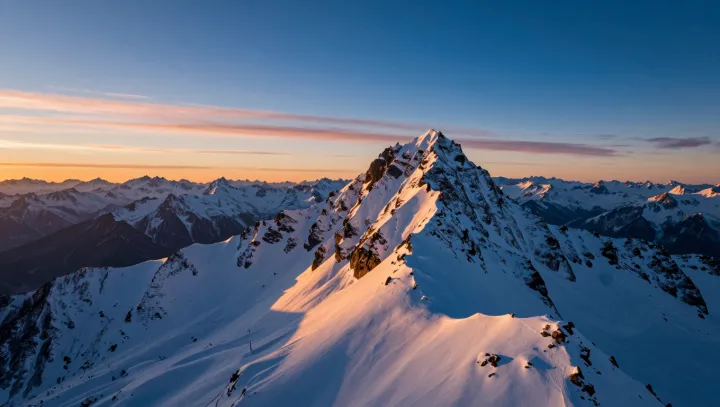
Gold arrives before warmth. At dawn, a snowfield high on a peak acts less like a colored surface than a demanding mirror, returning the altered spectrum of a Sun seen through a long atmospheric path. The mountain is not gilded. It is reporting.
The air is the real artist. When the Sun hangs low, its rays cross far more atmosphere than they do at noon, and Rayleigh scattering sends shorter blue wavelengths outward in many directions. Red and orange wavelengths remain stronger in the direct beam. Snow, with its high albedo, reflects much of that warmed spectral irradiance back toward the observer. White snow borrows the light.
Vision makes the effect feel almost excessive. Blue skylight often fills shaded gullies while sunlit slopes receive the amber direct beam, creating a sharp color contrast that the eye reads as gold against cobalt shadow. Within the snowpack, multiple scattering among ice grains spreads the incoming light without supplying much color of its own. For a brief interval, the peak seems to hold fire, though it is only returning what the sky has spared.