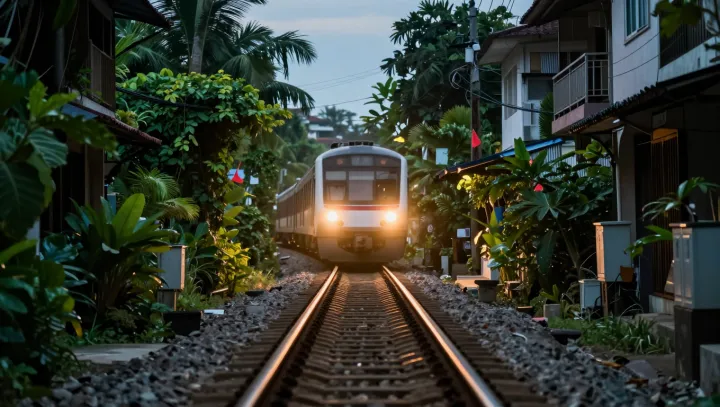
The scene looks improbable: steel wheel flanges skim past curbs, parked cars, and platform edges, while overhead wire hangs above a lane barely wider than the vehicle itself. This is not railway mimicry. It is railway geometry compressed into public space, where a train must obey the kinematic envelope of a street before it can exploit the load capacity of its track.
The trick is disciplined compromise. Street-running works only when wheel-rail adhesion, axle load, and braking distance are designed against tight radii, mixed traffic, and pedestrian crossings rather than treated as separate problems. Curves punish laziness. Engineers use larger-radius turnouts where space permits, resilient track slabs to limit vibration, and rail profiles that manage flange contact; they also restrict speed because lateral force rises sharply in confined bends. Power complicates everything. A heavy railcar needs traction equipment, cooling, crashworthy structure, and often catenary clearance, yet its doors and floor height must serve stops built into sidewalks. Vehicle dynamics is the real science. Think of the street as a bandwidth-limited network: the train is a data packet whose mass, stopping curve, and dynamic envelope must be scheduled through intersections without collisions or deadlock. Signals enforce the rules. At crossings, interlocking logic can reserve movement, traffic signals can grant priority, and track circuits or axle counters can confirm occupancy; each device turns a crowded block into a controlled operating zone. The payoff is hard-nosed. One corridor can carry passengers and, in some systems, freight without buying a separate right-of-way, though noise, maintenance windows, and public acceptance set the price. Once sensors, automated protection, and electrification operate as one control stack, the street railway gains the reflexes of a machine.