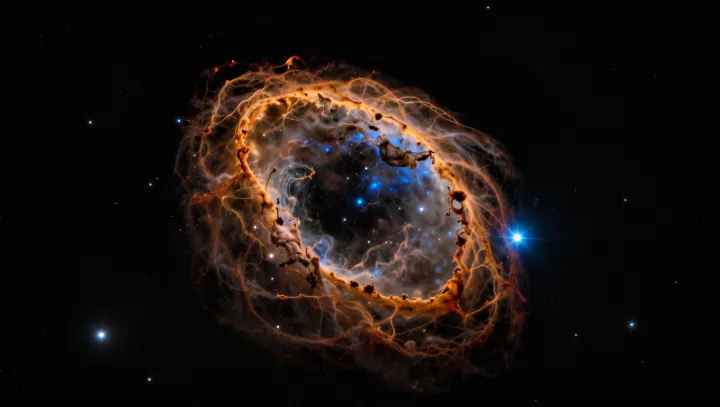
Those clouds were galaxies. Many objects once cataloged as spiral nebulae proved to be separate stellar systems containing billions of stars, rather than patches of gas tucked inside the Milky Way. The name concealed scale. Through telescopes that could not resolve their individual stars, these distant assemblies appeared as hazy spirals, inviting a classification that mistook appearance for physical identity.
Distance broke the illusion. In Andromeda, observations of Cepheid variables, stars whose pulsation periods reveal their intrinsic luminosities, supplied a way to calculate how far away the apparent cloud actually lay. Brightness alone could deceive. By applying the period-luminosity relation and comparing intrinsic luminosity with apparent brightness, astronomers placed Andromeda far beyond the Milky Way, establishing that it was a galaxy in its own right. The arithmetic redrew everything. Andromeda lies about two and a half million light-years away, whereas the Milky Way's stellar disk spans roughly one hundred thousand light-years.
The correction still matters. Although the historical label survives in accounts of astronomy, a spiral galaxy contains stars, interstellar gas and dust bound together by gravity, with dark matter contributing much of its mass. Not every nebula graduated. Genuine gas clouds remain within the Milky Way, including regions where stars form and shells expelled by dying stars; the mistake was treating distant spiral systems as comparable objects. Names can shrink reality. Where the telescope once offered a smudge, an entire galaxy was already shining, indifferent to the smallness of its assigned name.