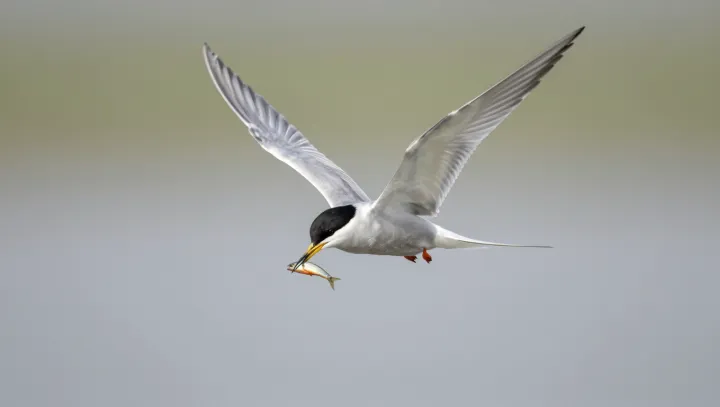
A tern's target is not quite where it seems. Light bends as it passes from water into air, shifting the apparent position of a fish viewed from above. Yet the bird dives anyway, sometimes emerging with its prey held neatly in its bill. The catch conceals a difficult problem in optics.
The distortion is predictable, but that does not make the hunt simple. Refraction generally makes an underwater object appear shallower than it is, with the apparent displacement depending on the viewing angle and the depth of the fish. A tern looking straight down faces less angular displacement than one watching from the side. Movement complicates matters. As the bird descends, its viewing angle changes, the fish may swim, and ripples can disturb the image. The bird must direct its bill toward a moving target across a boundary that changes the path of light.
The tempting answer is that terns simply calculate the correction, but their precise visual strategy remains uncertain. They may benefit from approaching near vertically, where refraction produces less sideways displacement, and from adjusting their trajectory as they descend. Experience and visual feedback could also help, although the relative importance of those mechanisms is not settled. A successful catch does not reveal which cues the bird used, or whether the same approach works across tern species and water conditions. Above the water, the fish is an image; below it, the bird must meet the real thing.