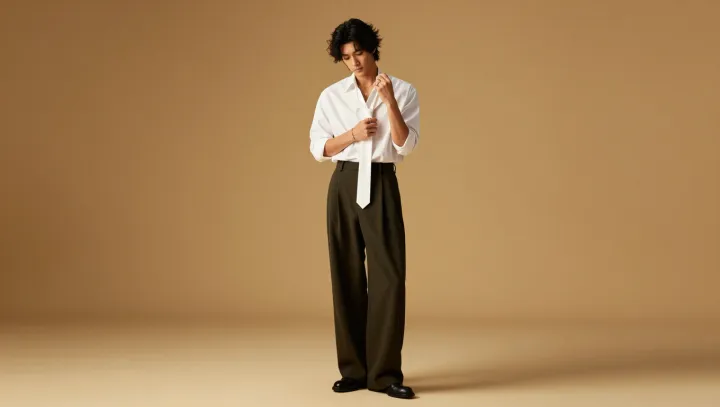
A long tie works best when it does not hide the waist. Against a white shirt and dark, wide-leg trousers, the tie draws the eye downward, while the exposed waistband marks where the upper body ends and the fuller legs begin. The distinction matters. Without it, the layers can blur into one uninterrupted column.
The trousers do more than provide a backdrop. Their high rise places the waistband above the hips, giving the shirt a shorter visual field and making the legs appear longer; their width, meanwhile, supplies enough volume to hold its own against a tie that extends below the waist. This is proportion at work. A narrower trouser might make the same tie look conspicuously long, while a very broad tie could overwhelm the shirt. The point is not to match dimensions precisely, but to let each piece register without swallowing the others.
Visibility is the quiet discipline of the outfit. Tuck the shirt cleanly, then let the tie fall over only part of the waistband so that its line remains legible on either side. The tie need not end at an exact point. Its effect depends on the trouser rise, the width of the waistband and how much shirt remains visible above it. Adjust the knot or choose a different tie if the tip covers too much of the fastening; a small shift can restore the division without sacrificing length. Here, restraint gives shape to abundance.