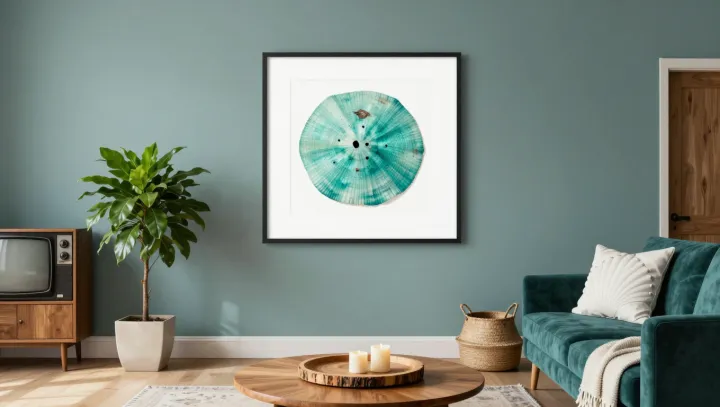
Dark walls need not close a room in. Deep teal can make the edges of a living room less conspicuous, especially when a dark green sofa sits against it and the transition between furniture and wall becomes less abrupt. The room has not grown. Its boundaries are simply less insistent.
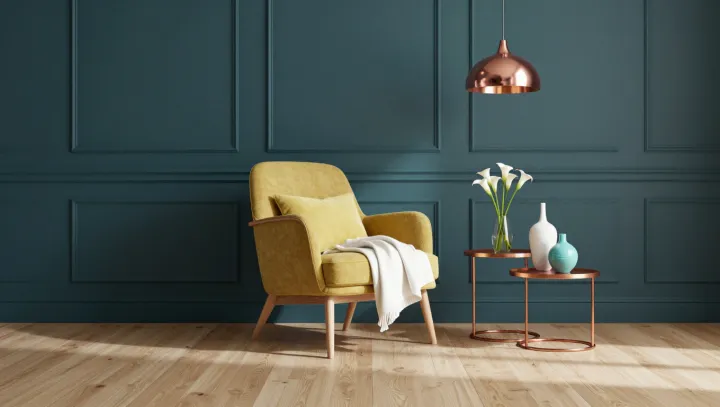
Light does the persuading. Daylight falling across teal reveals shifts in hue, while lamps that illuminate walls as well as seating can add depth after dark. Luminance contrast, the difference in perceived brightness between adjacent surfaces, helps explain the effect: a wall that fades gently into shadow reads differently from one cut off by a stark band of light. But darkness is no guarantee of spaciousness. If corners disappear altogether, the room may feel smaller instead.
Natural accents supply the counterpoint. Warm wood catches light against the cool walls; leafy plants break up broad surfaces with irregular shapes and shadows. Coastal artwork can introduce lighter tones and a suggestion of distance, giving the eye somewhere to travel without demanding another window. Color constancy also plays a part: the teal may seem to shift as daylight gives way to lamplight, even though the paint remains unchanged. A pale cushion or a light rug can sharpen the contrast, but too many bright interruptions may make the wall feel fragmented. Against the teal, a single leaf holds the light.