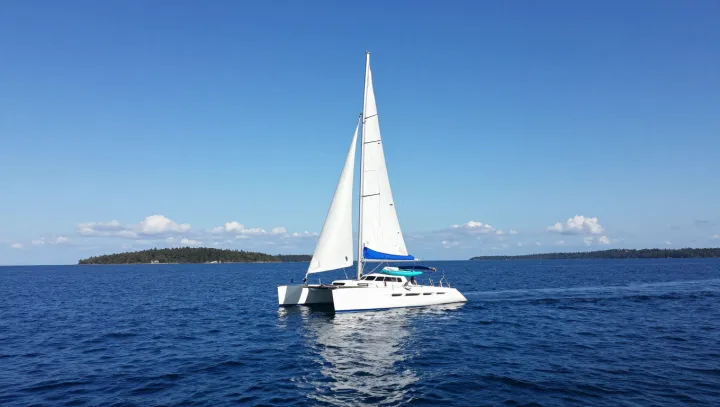
A catamaran's greatest comfort can become its greatest liability. Two parallel hulls, joined by a broad deck, resist the sideways tilt that makes life aboard a monohull feel like a balancing act. But if wind or waves push the boat past its range of positive stability, that same breadth can help keep it upside down.
The advantage is geometry. As the boat heels, the leeward hull takes more of the load while the windward hull unloads, separating the forces of buoyancy and gravity. That separation creates a righting moment, a torque that pushes the vessel back toward level. On many cruising catamarans, the wide platform also leaves room for cabins and living space. Yet stability has limits. If the heeling force becomes large enough, a hull can lift, and the boat may roll beyond the angle at which its righting moment can restore it.
Recovery is another matter. Once inverted, the hulls can still provide buoyancy, and their separation can resist the roll needed to turn the vessel upright. The distribution of weight and buoyancy, as well as the shape of the hulls and deck, determines how stable a particular boat is in that position. A monohull with a sufficiently heavy keel may roll back upright after a knockdown; a cruising catamaran generally cannot count on doing the same. Righting an inverted vessel can require substantial external force and specialist equipment. The deck that made the horizon feel steady may end up facing the sea.