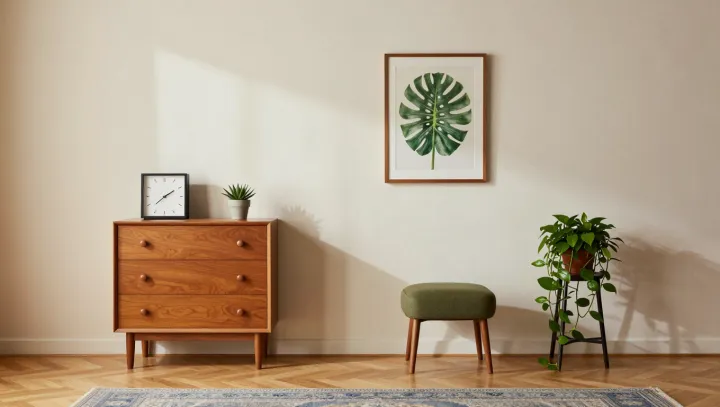
Plants are not an afterthought in a mid-century room. They complete its argument. Against the clean lines of wooden furniture, leaves introduce the irregular shapes that industrial production tends to smooth away, while their green offers a fresh contrast to the warmth of timber. The result feels composed without becoming rigid.
The affinity runs deeper than color. Mid-century designers embraced mass production, yet many also drew on organic form: curved chair backs, tapered legs and surfaces shaped to fit the body. Molded plywood made such curves repeatable, bringing a natural-looking silhouette within reach of factory production. A plant extends that conversation. Its branching stems and uneven leaves echo the furniture's curves without pretending to share its precision. Botanical artwork adds another layer, translating living shapes into marks that can sit comfortably beside a carefully made table or cabinet.
Restraint makes the pairing more persuasive. A single broad-leaved plant beside a low cabinet can give the eye a place to rest, while a botanical print above it draws attention upward. Too many small pots, by contrast, can obscure the furniture's distinctive outlines and turn a considered arrangement into clutter. Light matters as well. Choose plants suited to the room's actual conditions rather than placing them solely for effect; a healthy leaf does more for the composition than a struggling specimen in the perfect spot. The furniture holds its shape. The leaves keep changing.