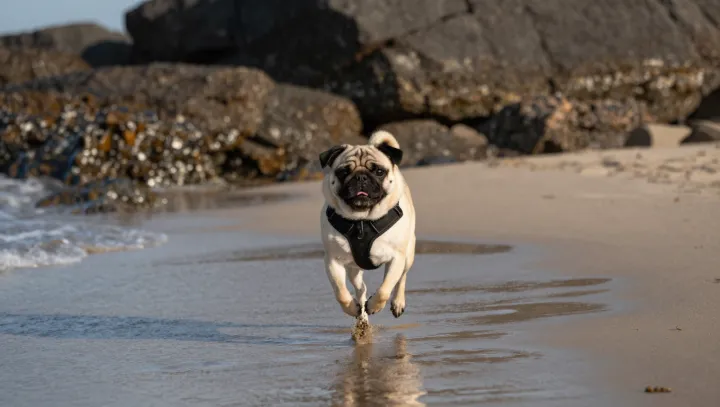
A pug's cheerful dash across the sand carries a hidden cost: the short muzzle that gives the breed its familiar face can make shedding heat harder. The contrast is striking. While the compact dog bounds forward, its breathing apparatus may already be working harder than its stride suggests.
The difficulty lies in the design. Dogs cool themselves chiefly through evaporative cooling: panting moves air over moist surfaces in the mouth and respiratory tract, allowing water to evaporate and carry heat away. In brachycephalic dogs, a shortened skull can crowd soft tissues into a smaller space, leaving narrowed nostrils or an elongated soft palate that restricts airflow. That is not a trivial squeeze. Increased breathing effort can generate additional heat, while limited airflow makes panting less effective. Warm, humid conditions and exercise can push the system harder still.
A beach run deserves more caution than its playful appearance suggests. Heavy or noisy breathing, weakness, excessive drooling or collapse can signal dangerous overheating, although individual dogs differ in their tolerance. Move an overheated dog to a cool place, wet its coat with cool water, use airflow and contact a veterinarian promptly; severe signs require emergency care. Prevention asks less of the animal: offer water and shade, and keep activity gentle when conditions are warm. On the sand, a small figure races the tide, carrying an inherited constraint in every breath.