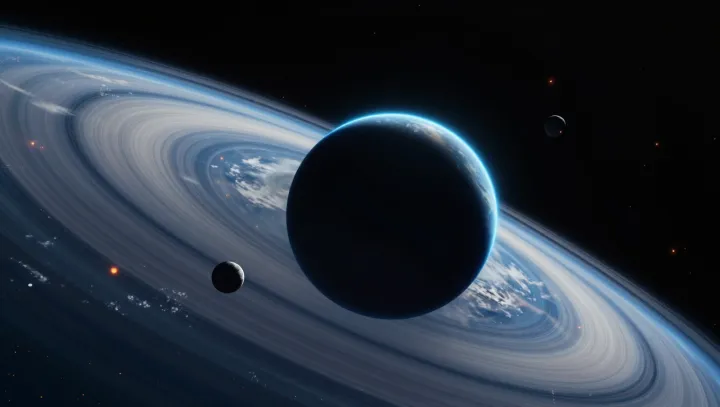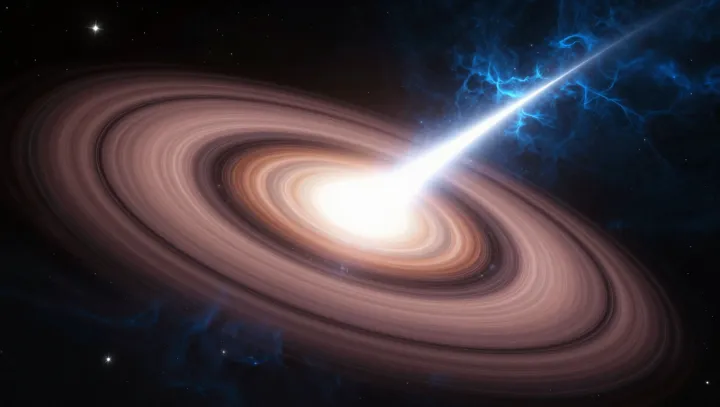
Black holes do not need to release what they have swallowed to launch a jet. The distinction is everything. Outside the event horizon, the boundary beyond which light cannot escape, matter can still move outward, even as other material spirals inward through a hot accretion disk.
The disk is more than a feeding chute. Its gas becomes plasma, a mixture of charged particles that drags and twists magnetic fields as it circles the black hole. Those fields can channel some of the gas away from the disk and focus it into jets along the system's axis. Spin may help too. In the Blandford-Znajek mechanism, magnetic fields threading the region around a rotating black hole can extract some of its rotational energy and carry it outward. The energy is not a parcel climbing back through the event horizon; it is drawn from the black hole's spin through interactions outside that boundary.
The picture is compelling, but the details remain unsettled. Not every black hole produces a conspicuous jet, and researchers are still investigating how magnetic fields gather, how particles gain energy and which conditions make a jet powerful. Observations of light emitted by fast-moving plasma offer clues, though they do not reveal every step of the process. A dark boundary keeps its silence while matter beyond it announces itself across space.