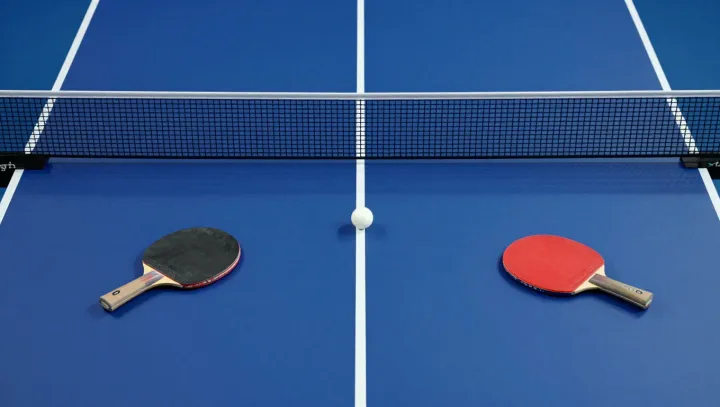
A ball skimming just above the table tennis net can carry more tactical security than a blistering drive that flies higher. The geometry of the arc sets a narrow window for counterattack, while the same net height becomes a hard constraint for any opponent trying to hit aggressively through it.
The key variables are trajectory, angular velocity and net clearance, not just linear velocity. A low, heavily spun ball travels on a shallow parabolic path defined by gravity and initial launch angle, with the Magnus effect curving it down onto the table. Because the ball passes only a few millimeters above the net, any attempted flat hit must negotiate both that fixed barrier and the short distance to the end line, shrinking the margin of error to a thin strip of playable space.
By contrast, a faster, higher ball offers a taller contact window and more vertical space to accelerate the racket, effectively enlarging the opponent’s attack cone. Defensive players use backspin and precise arc control to lock rallies into this low corridor, converting spin and placement into a kind of safety buffer. In a sport decided by millimeters, the safer shot often owes its advantage less to raw speed than to how it bends space around the net.