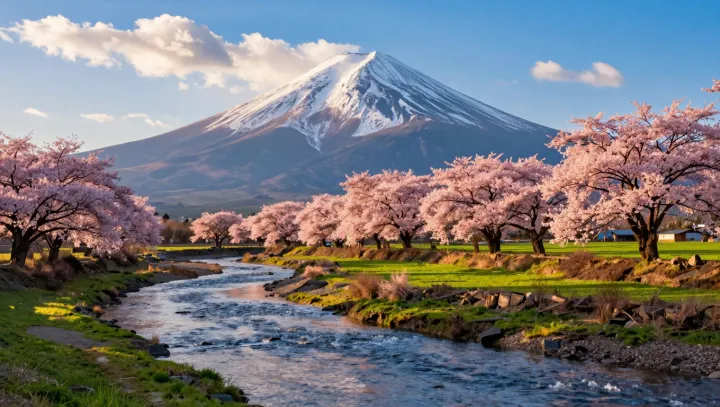
Mount Fuji’s Hidden Private Landlord
Japan’s Mount Fuji, a national symbol, is largely owned by a private religious organization that leases land to public authorities, shaping park management and visitor access.

Japan’s Mount Fuji, a national symbol, is largely owned by a private religious organization that leases land to public authorities, shaping park management and visitor access.

The winter‑blooming plum blossom rose to the top of Chinese floral rankings because its biology and timing matched ideals of moral resilience and cultured restraint.

Kiwifruit, often treated as a background fruit, quietly surpasses many trendy snacks in fiber, vitamin C, antioxidants, calorie density and cost efficiency.

A once‑derided metal frame evolved into the archetype for urban skylines and tourist towers, merging engineering efficiency with symbolic power in national branding.

Belgium appears as one of Europe’s brightest zones from space because of ultra‑dense road lighting, continuous urban sprawl and planning choices that keep artificial illumination switched on across the map.

Explores how the LVVolt collection arranges the L and V monogram into a rhythmic visual pattern that triggers motion perception through repetition, contrast and Gestalt grouping.

Young drivers are shifting from traditional dream cars to compact, tech-heavy EVs, prioritizing software, connectivity, and total cost of use over raw power and luxury.

Two people read the same star‑filled sky in opposite romantic ways because their brains fuse raw sensory data with memory, prediction and social context to construct meaning.

Mount Kailash anchors the headwaters of four major Asian rivers not by a summit spring, but through its role as a watershed divide shaped by tectonics, glaciation and regional monsoon dynamics.

Research suggests indoor plants and thoughtful pot design can absorb pollutants, modulate stress responses and shift visual perception so homes feel brighter without extra light.

Neuroscientists are finding that downhill skiing recruits dopamine, reward prediction error, and motor control circuits in patterns that resemble addictive behaviors, despite the sport’s natural setting.