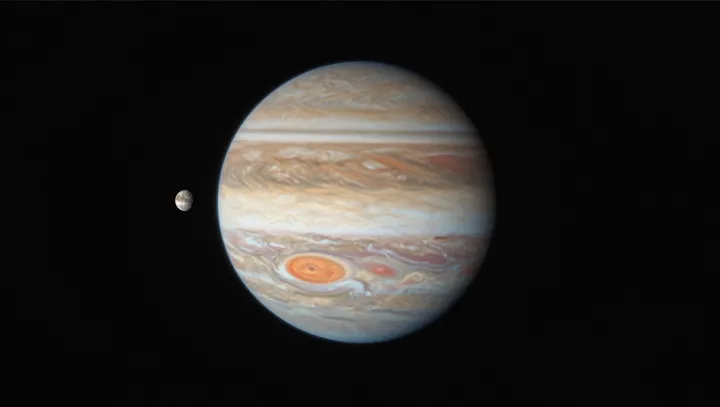
A storm large enough to swallow Earth is shrinking, yet it remains one of the most powerful features in the Solar System. Jupiter’s Great Red Spot, a colossal high‑pressure vortex, has steadily contracted in width while its winds and color gradients stay intense. The paradox has turned the storm into a live experiment on how giant planet atmospheres move energy and momentum.
High‑resolution imaging and spectroscopic data show that as the storm narrows, its cloud tops tower higher and its wind field tightens. In fluid dynamics this is a classic vorticity and angular momentum story: a smaller radius forces faster rotation, much like an ice skater pulling in their arms. Beneath the visible clouds, models of convection and differential rotation suggest a deep reservoir of kinetic energy feeding the vortex, an atmospheric “hidden engine” that redistributes heat instead of allowing simple radiative cooling.
Researchers now treat the storm as a probe of Jupiter’s interior stratification, using observations of potential vorticity, vertical shear and wave propagation to infer how far the circulation column extends below the cloud deck. If the vortex is rooted deeply in layers governed by baroclinic instability and strongly varying density, its gradual shrinkage could mark a long rebalancing of entropy and energy flux within the planet’s fluid envelope, rather than the simple decay of a dying storm.