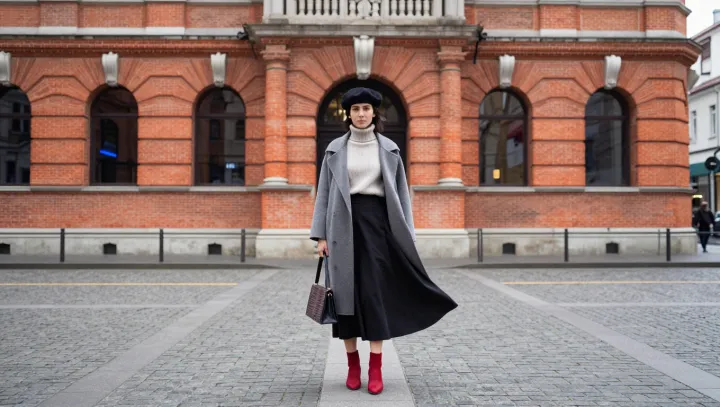
A long skirt that covers most of the leg can act like a quiet piece of optical engineering, rearranging how the eye reads the body. Instead of exposing cuts of skin at the knee or mid-thigh, a continuous column of fabric creates one unbroken vertical line, which the brain interprets as extra height rather than extra cloth.
The effect is essentially a lesson in proportion and visual hierarchy. When the hemline drops closer to the ankle and the waistline is clearly marked, the torso-to-leg ratio shifts, nudging the perceived center of gravity upward. That change alters the marginal effect of every styling choice above it: a tucked shirt, a narrow belt, even a simple neckline all gain leverage because the base silhouette is already elongated.
At the same time, a longer skirt softens local visual noise around the thighs and knees, allowing the silhouette to read as a single shape instead of a series of joints and angles. Movement matters as well: fabric that sways in a controlled arc frames the gait, adding a measured cadence that reads as poise. What looks, on a hanger, like more coverage becomes, in motion, a subtle edit of line, rhythm, and attention.