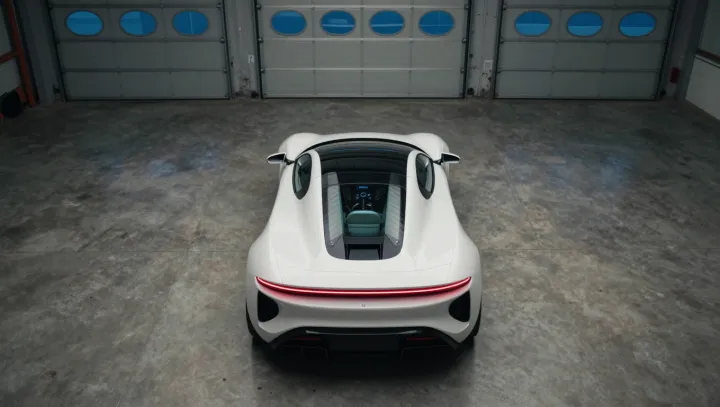
A wedge of white bodywork looks almost flat against the air, but the Bugatti Centodieci is quietly rewriting the physics behind that surface. The car borrows the boxier stance of a nineties supercar, yet packages a powertrain and airflow concept that belong to a radically different era.
The Centodieci keeps its upright nose and slabby flanks only in silhouette; in section, nearly every panel is sculpted as an airfoil. Hidden channels around the horseshoe grille and under the front splitter guide flow to reduce the coefficient of drag while generating stable downforce. The five round side inlets echo an old design cue, but behind them sit carefully sized ducts that feed charge‑air coolers and brake cooling circuits, tuned using computational fluid dynamics and wind‑tunnel feedback.
Above the engine, a shallow rear deck appears almost planar, yet integrates a pressure recovery zone and a fixed wing that manage boundary layer separation. This allows the 1,600‑hp quad‑turbocharged W16 to operate within tight limits of thermal efficiency without resorting to large, visually disruptive intakes. Structural elements inside the bodywork act as flow fences and vortex generators, shaping wake behavior while preserving torsional rigidity. What reads as a nostalgic, blocky outline is in practice a high‑speed air management system wrapped around an internal combustion power plant operating near the edge of its specific output.