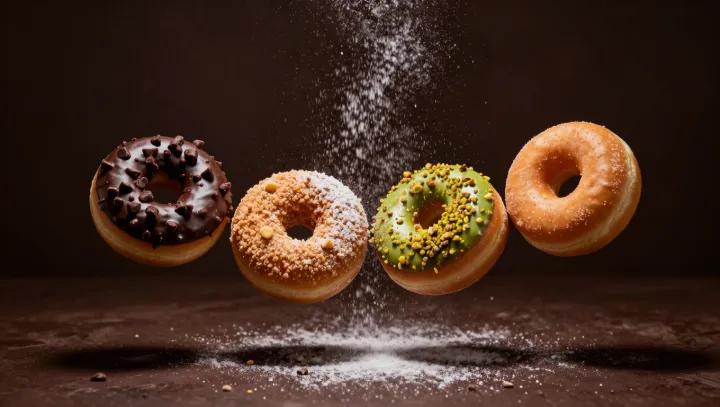
A donut in free fall accelerates downward with the same gravitational acceleration as a rock, yet a video can make it appear to float. The key is not a change in gravity but a change in reference frame between the donut, the camera, and the background.
During true free fall, the donut experiences apparent weightlessness because only gravity acts on it; its proper acceleration is effectively zero. If the camera tracks the donut’s motion, matching much of its downward velocity, the donut stays near the center of the frame while the background streaks past. The relative motion between donut and camera shrinks, so the donut’s path looks slow even though its absolute acceleration g is unchanged.
High frame rate recording and short shutter time further stretch perception. More frames capture small changes in position, and motion blur is reduced, so the fall can be replayed in slow motion without losing sharpness. The visual system anchors speed to nearby objects, so a stable donut against a moving background reads as gentle drift rather than rapid gravitational free fall.