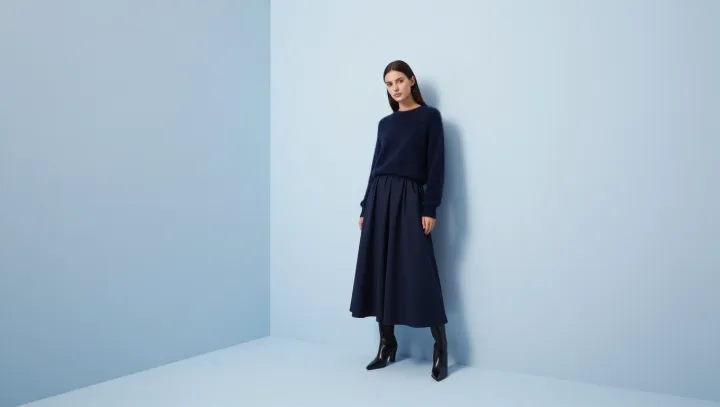
Soft, diffused light, not brutal brightness, gives a midnight-blue velvet dress its hardest edge. Under a hazy glow, the pile absorbs photons, deepens the chroma, and creates high local contrast along seams and folds, so the garment reads as a single, deliberate silhouette rather than a noisy surface.
Authority here is an optical trick first, a social construct second. Human vision leans on luminance contrast and edge detection in the primary visual cortex; when harsh light flattens the velvet with specular reflection and blown-out highlights, those edges smear, the nap looks patchy, and the dress appears cheaper, almost uncertain in outline. Under softer illumination, specular glare is suppressed, so micro-shadows within the fabric’s pile become legible, giving the brain richer texture gradients and a cleaner boundary against skin and background, which it then codes as firmness and control.
Style psychology quietly exploits this bias. Dark, light-absorbing textiles worn in controlled, low-glare environments trigger associations with uniforms, formal robes, and stage costumes, all of which historically used depth of color and matte texture to signal hierarchy. A midnight-blue velvet dress that looks sharper in softness than in blaze exposes a simple fact: power dressing depends less on the garment than on the lighting rig framing it.