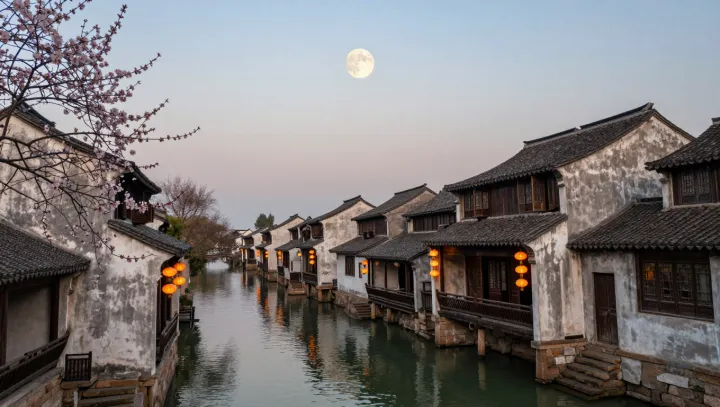
Stone, not steel, runs the real cooling network in Xitang. Narrow canals pressed against continuous rows of houses create a long contact zone where water and masonry trade heat, while the sunless alleys between them act like venturi ducts that accelerate air as temperatures fall after dusk.
This old town behaves less like a postcard and more like a calibrated microclimate device. During the day, canal water absorbs radiant energy and stores it thanks to its high specific heat capacity, while deep eaves and arcade‑style corridors cut direct solar gain on walls and pavements, reducing the urban heat storage that usually drives oppressive nights in dense districts.
What feels like a quiet stroll is actually applied fluid dynamics. As roofs and stone facades cool faster than the water surface, a temperature gradient sets up buoyancy‑driven convection: cooler, denser air slides along the shaded alleys, warmer air lifts off the canals, and a slow but persistent breeze is pulled through window bays that face both water and lane, flushing indoor heat without mechanical ventilation.
The town’s famous waterside arcades make an even bolder claim: that evaporation is better than any fan. Exposed canal surfaces under night air feed latent heat flux, where phase change from liquid to vapor strips energy from surroundings, while the close spacing of buildings traps just enough humidity to soften, not smother, the thermal profile for people sitting on stone steps above the waterline.