Nothing about a black hole is intuitive, least of all its treatment of time. Near the event horizon, the equations of general relativity do not politely disagree with common sense; they shred it. Spacetime is so sharply curved that the usual order of events depends on where you watch from, and that is the quiet scandal behind the falling astronaut.
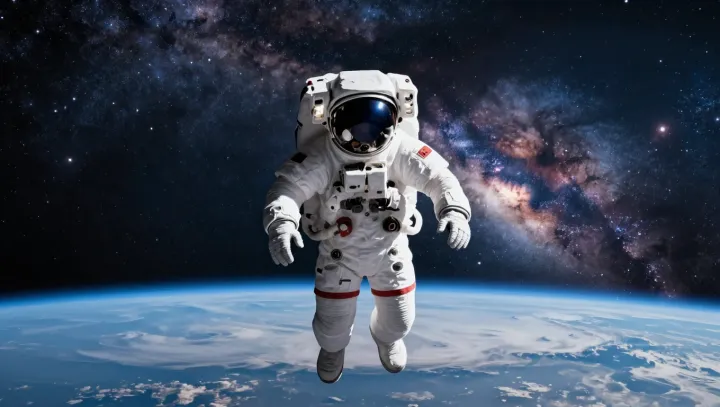
From the distant observer’s frame, the verdict is harsh. Gravitational time dilation and redshift slow every signal from the astronaut as they approach the event horizon. Light takes longer to escape, its wavelength stretched until it fades into darkness, so the astronaut appears to crawl, then stall, never quite crossing that invisible boundary. In the coordinate time used by faraway clocks, the crossing is pushed toward an endless wait.
From the astronaut’s own frame, the story is almost the opposite, and far more dramatic. Proper time along their worldline stays finite; they reach and pass the event horizon in a brief, continuous fall. Inside, spacetime funnels all possible paths toward the singularity, compressing the outside universe’s history into what can, in some models, arrive in a flood of incoming light. Where one vantage point sees a frozen outline, another rides a fast track through the universe’s remaining script.