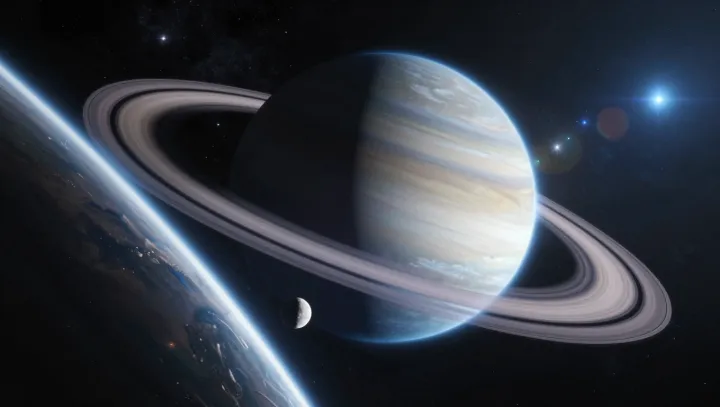
Saturn cheats your intuition. A world that could swallow more than 700 Earths looks like a rock-solid heavyweight, yet its bulk is so airy that, scaled up, it would float in a cosmic bathtub.
The trick is density, not size. Saturn’s mass is huge, but its radius is even larger, which drives its mean density below that of liquid water. That happens because the planet is dominated by molecular hydrogen and helium, elements with low atomic mass that form an extended gaseous envelope instead of a compact solid crust. Under high pressure, hydrogen transitions toward metallic hydrogen, but the overall mass is spread through such a wide volume that the kilograms per cubic meter stay surprisingly low compared with water’s benchmark value.
This makes the planet more like a gigantic foam ball than a marble. Gravity squeezes its gases, yet hydrostatic equilibrium stops the collapse once internal pressure balances weight, locking in that low average density. Add fast rotation and the planet bulges at the equator, distributing material even more thinly. So the bathtub thought experiment is not about a gentle, bobbing sphere; it is a reminder that human senses, tuned to rocks and oceans, fail badly when confronted with a hydrogen colossus whose physics is ruled by equations of state, not everyday experience.