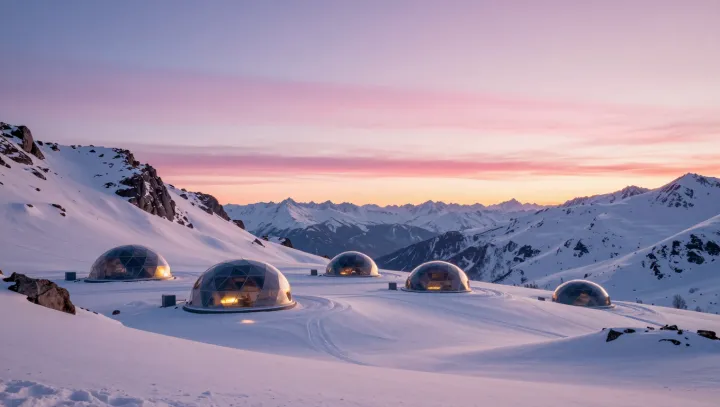
Glowing domes in a frozen mountain bowl look theatrical, yet their light makes a blunt claim: this white surface is active infrastructure for the planet. Each beam hitting the snow feeds instruments that track albedo, the fraction of sunlight bounced back to space instead of heating air and ocean.
That reflective power is not subtle. Bright snow can return most incoming shortwave radiation, and radiative transfer models show that even small darkening by soot or dust amplifies energy absorption, reshaping melt patterns downslope. Inside the domes, spectroradiometers and lidar units parse wavelengths and scattered photons, turning the bowl into a calibrated mirror that reports, in real time, how efficiently this high‑altitude skin cools Earth.
Yet the same surface that rejects today’s heat quietly hoards yesterday’s weather. Fresh storms stack as discrete layers, each with its own density, trapped air bubbles, and isotopic ratios of oxygen and hydrogen that encode past temperature and moisture source. Snow compacts into firn, then ice, and boreholes or ice cores later read those strata like a vertical archive of greenhouse gases, volcanic sulfate, and black carbon. In a single glance, the glowing domes frame both functions: a cold shield flashing sunlight away, and beneath it, a slow, accumulating script of climate change written in frozen light and buried layers.