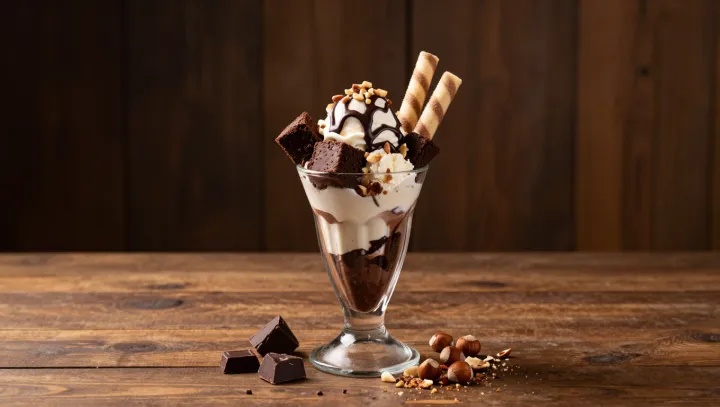
A simple chocolate–nut sundae can outclass premium ice cream. Not by fancy machines, but by chemistry in a mixing bowl that slows how water solidifies into jagged ice structures inside a home freezer.
The bold move is to raise sugar slightly above what taste alone would suggest. Sugar lowers the freezing point by colligative properties, so part of the water stays in an unfrozen, syrupy phase, and that syrup blocks large ice crystal growth through what physicists call diffusion limitation. The result is smaller crystals, less crunch, more glide on the spoon. Too much sugar, though, and the mix becomes slushy rather than scoopable, so the target is a narrow band where the dessert is soft but still structurally stable.
Even more decisive is fat. Boosting cream and nut content adds a continuous fat network that coats forming ice crystals, a process described in food science as fat destabilization and partial coalescence. Those fat globules act like insulation and physical barriers, slowing recrystallization each time the freezer door opens and the temperature fluctuates. Nuts contribute extra fat and solids, thickening the matrix and increasing viscosity, which further retards molecular motion and crystal enlargement. With sugar tuning the freezing curve and fat reinforcing the microstructure, a home sundae can remain scoopable long after many commercial tubs have turned grainy.