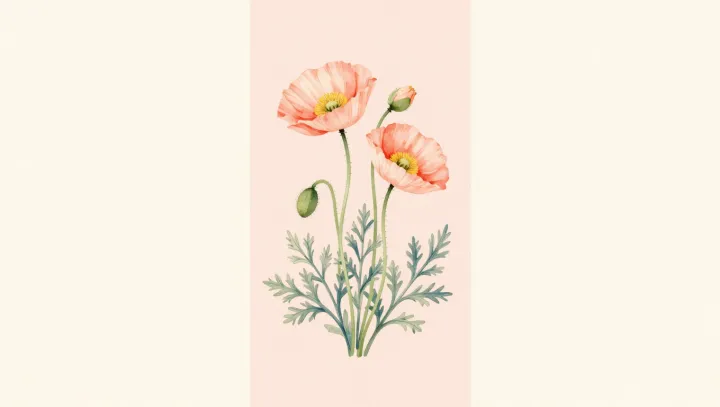
Those flimsy, see‑through petals are not weak at all; they are brutally efficient optical devices. Their color depends less on piles of pigment and more on how they scramble incoming light through structure, using tricks that printing ink on paper simply cannot match.
At the heart of the effect is disorder, not order. Inside many wildflower petals, microscopy reveals a foamy network of air cavities buried just beneath the outer cell layer, a mess of interfaces that creates intense Mie scattering when white light hits. Every air pocket sits next to watery cell tissue, so the refractive index jumps sharply at each boundary and light is kicked sideways again and again before it escapes.
This repeated scattering boosts path length. So even a thin petal, with sparse pigment molecules, can absorb selected wavelengths very effectively while still sending plenty of light back to the eye. Pigment sets the spectral filter; the structural matrix provides gain. Compared with the flat, mostly uniform coating of pigment on paper, the petal behaves like a three‑dimensional diffuser, multiplying every photon’s chances of meeting a pigment molecule before leaving as a soft, pastel signal.
What looks like fragility in the field is, under the lens, a tight alliance of optical physics and plant anatomy, turning almost transparent tissue into a surprisingly loud whisper of color.