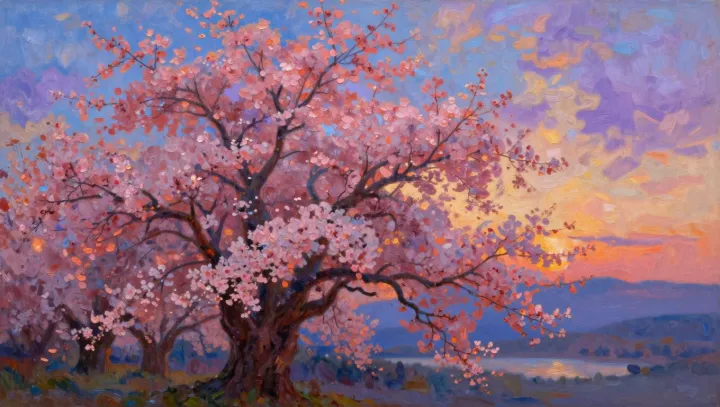
Those almond blossoms are not gentle at all. Against a receding band of pale sky, the thin pink petals function like litmus paper, registering stress in a mind that refused quiet while the surface of the canvas insists on calm. The branch cuts across the picture plane with deliberate angles, almost diagrammatic, as if the painter were drafting rather than confessing, forcing unruly feeling to occupy a fixed visual grid.
This is not sentiment; it is method. Color theory becomes his lab discipline, with saturated turquoise and controlled pink set in complementary tension, keeping emotional intensity inside a limited palette the way a laboratory keeps fumes inside glass. Line behaves like a stabilizer bar: the forked twigs distribute visual weight, creating a near-symmetrical armature that counteracts the psychological asymmetry we know from his letters, where agitation, insomnia and what a clinician would call affective instability keep breaking through.
The real experiment sits in the edges. Every blossom is cropped by the frame or anchored to a branch, so nothing floats free, no matter how airy the subject might appear. Brushwork stays legible yet contained, directional strokes locking the sky into horizontal bands while the branch asserts a contrary diagonal. Emotional chaos presses upward, but the composition, like a carefully drawn clinical chart, refuses to spike.