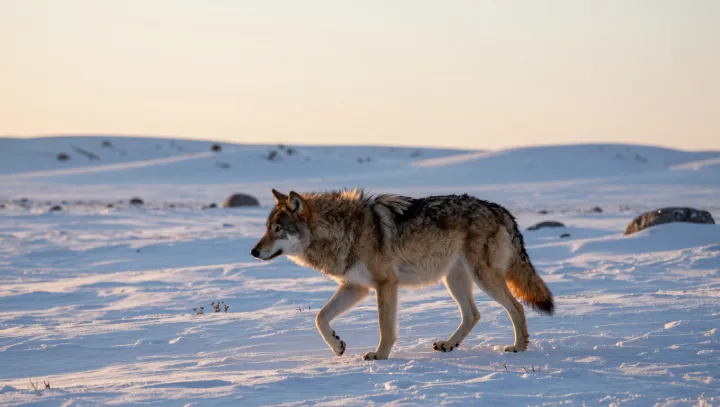
Frozen snow should betray a hunter. It crackles under boots, snaps under hooves, broadcasts every misstep. Yet a wolf, roughly forty kilograms of muscle and bone, can cross that same crust sounding like wind over ice.
The real marvel is not in the leg but in the paw, where evolution has quietly reengineered a basic carnivore foot into a multi‑layer damping system. Under each toe sits a thick plantar fat pad, partitioned by collagen septa into tiny chambers; when the paw hits the ground, those chambers deform, dissipating kinetic energy and flattening sharp pressure spikes that would otherwise ring through the snowpack like a drum hit.
Equally radical is the way this structure edits sound. By spreading load across multiple digital pads and a central metacarpal pad, the paw lowers peak ground reaction forces, which cuts the high‑frequency vibrations that brittle ice transmits so well. Keratinized yet flexible pads grip and release without the hard slaps typical of hooves or claws on crust, while thick fur between toes behaves like acoustic foam, scattering residual noise before it couples into the surface.
Hidden inside the same compact package is a control system. Dense networks of mechanoreceptors and proprioceptive nerve endings feed constant data to the spinal cord, allowing minute adjustments of joint angle and claw engagement mid‑stride. What results is not a delicate tiptoe, but a confident, well‑tuned gait that lets a heavy predator move across a noisy, frozen field as if the snow itself had agreed to keep its secrets.