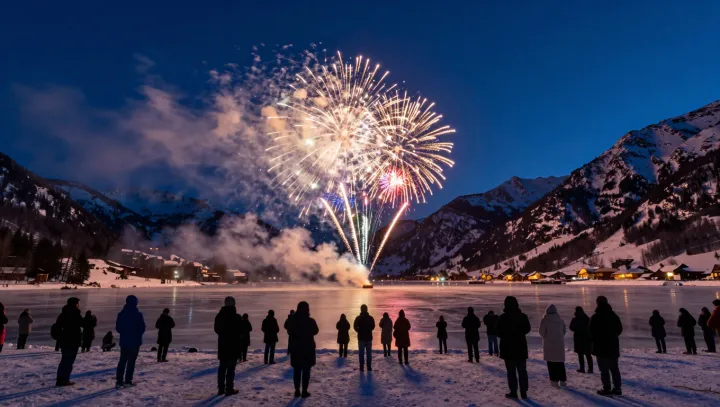
Perfection here is mechanical, not artistic. Above a frozen mountain lake, each burst is locked to a firing script in the control unit, while gravity, combustion chemistry and optics do the rest, turning ice into a flawless copy of the sky without a single brushstroke.
The real surprise is how little freedom the firework has. Black powder in the lift charge must reach a defined internal pressure before rupture, so the shell exits the mortar at a predictable velocity, climbs along a ballistic arc and arrives at a programmed altitude when a time‑delay fuse, based on controlled deflagration, ignites the break charge. Inside, metallic salts and metal powders are packed in carefully spaced star pellets; their combustion temperature and flame emission spectra dictate both color and burn duration, so the pattern blooms in three dimensions according to chemistry and geometry, not whim.
Even the mirror effect is not magic but optics under constraint. When the shell bursts roughly above the lake’s center, the expanding sphere of light sends rays downward at angles that the smooth ice‑water interface reflects almost like a first‑surface mirror, governed by the law of reflection and the near‑still air that limits turbulence. The lake, dark and flat, suppresses scattering and acts as a natural projection screen, so the geometry of the explosion is duplicated below with inverted symmetry, a perfect painting authored by pressure curves, reaction kinetics and Fresnel equations.