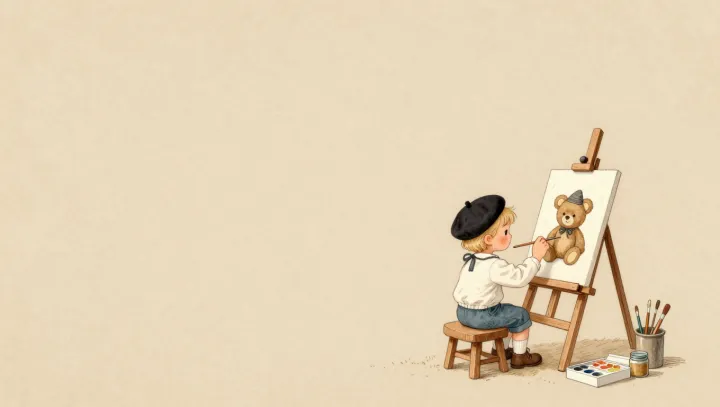
A rough teddy bear outline is a tougher teacher than a perfect photo. When a child draws that bear, the brain does not simply note shapes; it engages active motor planning and visual encoding, forcing frontal and parietal networks to coordinate how each curve, circle, and ear is constructed on the page.
Passive looking, by contrast, lets the visual cortex skim. Attention drifts. During drawing, however, every decision about contour, proportion, and negative space calls on working memory and pattern separation in the hippocampus, which must distinguish this bear from countless similar soft toys stored as prior traces. Short lines. Quick corrections. Each mark becomes a feedback signal, tightening the loop between hand movement and error monitoring in the cerebellum, so the child learns not just what the bear looks like, but how small deviations alter the entire figure.
The surprising edge of a cartoonish bear is its simplicity. By stripping away fur texture, lighting, and background clutter, it amplifies structural cues that drive object recognition pathways in the ventral visual stream. The young artist rehearses internal templates for circles, ovals, and joints, then recombines them, building a compressed visual code that later makes complex subjects easier to decode from memory.