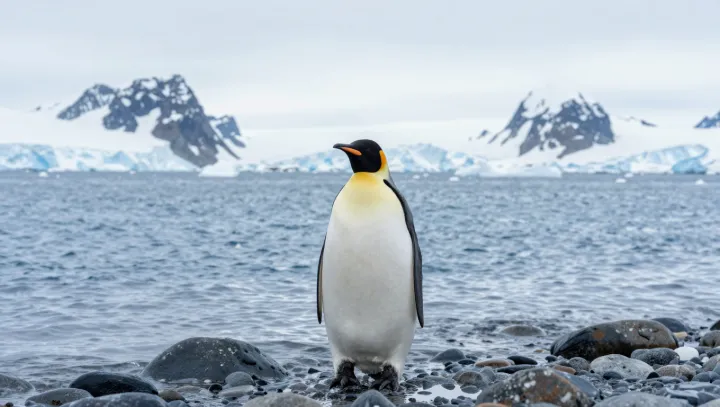
A standing emperor penguin is less a bird than a heat vault. Around that upright body, physics and physiology fuse into a compact survival machine that keeps core temperature near mammalian levels while air and ice fall far below the freezing point of seawater.
The real trick is not courage but insulation. A dense feather coat traps motionless air, a low thermal conductivity shield that rivals synthetic foam, while a thick subcutaneous fat layer adds another barrier to conduction from the ice. The feet, which should be its weak spot, are governed by countercurrent heat exchange: arteries and veins lie side by side, so warm arterial blood surrenders energy to returning venous blood, limiting loss into the frozen surface and keeping the core from bleeding heat into the extremities.
Yet the bird does not survive alone. A huddle behaves like living architecture. Hundreds of bodies pack into a shifting cylinder whose surface area relative to volume shrinks, cutting convective loss; inside, air temperature can sit tens of degrees higher than outside, while individuals cycle between exposed rim and protected center. Metabolic rate rises, brown adipose tissue and skeletal muscle oxidation ramp up, and peripheral vasoconstriction throttles blood flow to skin. By tolerating cold limbs, the penguin protects brain and organs, standing almost immobile as a precise thermodynamic compromise between death by freezing and starvation by wasted energy.
What looks like stoic stillness on the ice is, beneath the feathers and within the crowd, a continuous negotiation with entropy.