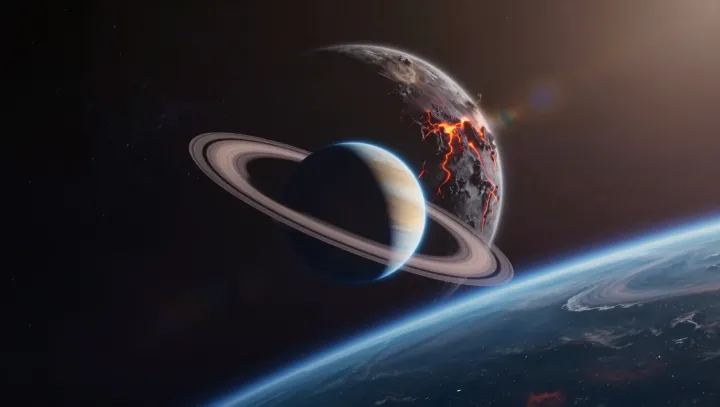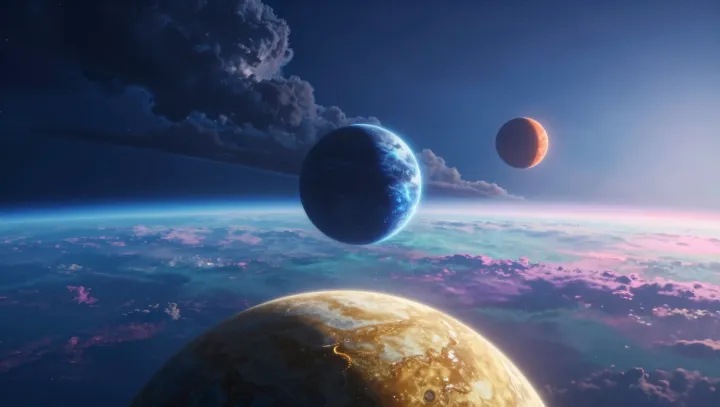
Giant planets can live perilously close to their stars, overturning the tidy expectation that gas giants belong far from the heat. Some hot Jupiters complete an orbit in just a few days, circling closer to their stars than Mercury does to the Sun. Their existence makes our own planetary arrangement look less like a template than one possible outcome.
The likely explanation is movement, not a single recipe for birth. In one scenario, a young giant forms farther out and undergoes disk migration: gravitational interactions with the protoplanetary disk alter its orbit and draw it inward. Another route is more violent. Gravitational encounters with other planets or a companion star can stretch an orbit; tidal forces may then shrink and round it. Formation close to the star is also possible under some conditions, although assembling enough material there poses challenges.
The orbits themselves carry evidence of these competing histories. A planet moving in step with its star's rotation can be consistent with disk migration, while a sharply tilted orbit may point to later gravitational disturbances. Neither clue settles the case alone: stars and planets can change their orientations through several processes. Measurements of orbital alignment, atmospheric composition and neighboring planets help astronomers test which pathways operate, and how often. The answer may be untidy. Across the many worlds now imagined and observed, the position of a planet is not necessarily the place where its story began.