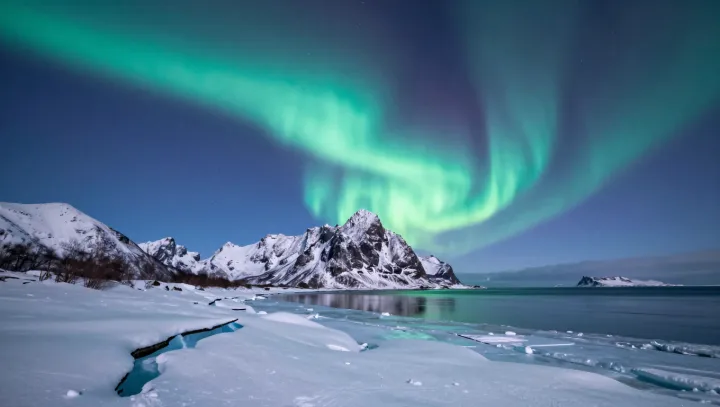
The aurora's colors are not a simple inventory of gases. Above snowy mountains, green ribbons and red veils can both come from oxygen atoms, their different hues shaped by altitude and the time each atom is allowed to hold its energy. The distinction is a matter of survival: an excited atom must emit light before a collision steals its chance.
Green has the advantage of speed. Charged particles, mostly electrons guided by Earth's magnetic field, excite oxygen atoms by transferring energy to them. When an atom drops from one excited state to another, it can emit a green photon; this transition typically takes less than a second. Green emissions are common roughly 100 to 150 kilometers above Earth, where the air is thin enough for many atoms to shine before colliding with other particles. The color is a signature of an energy difference between quantum states, not of a different kind of oxygen.
Red demands patience. Its oxygen transition takes roughly two minutes on average, leaving excited atoms vulnerable to collisional quenching, in which collisions remove their energy without the emission of a red photon. Higher up, often above 200 kilometers, the atmosphere is sparse enough for more atoms to complete that slow transition. Altitude is not the only influence: the energy of incoming electrons and the supply of oxygen also shape the display. Still, the contrast is striking. Above the fixed white peaks, a change in air's density can turn the same atomic substance into a different color of light.