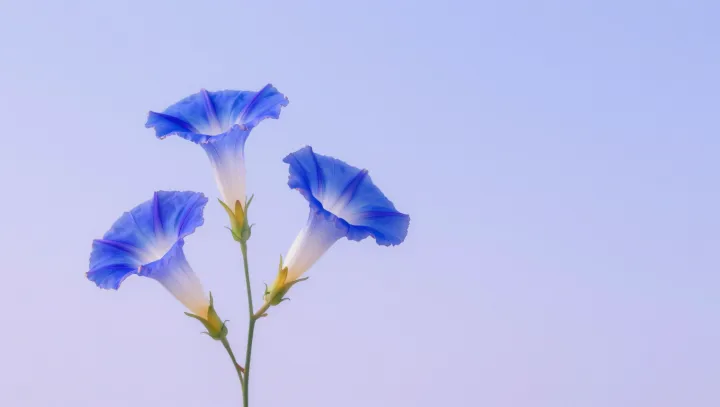
Blue flowers are an achievement, not a simple pigment choice. In a composition of three trumpet-shaped blooms, slender stems rise against a soft blue background; the apparent simplicity conceals a demanding bit of chemistry. The same pigment family that can produce red and purple can also yield blue, but only under particular conditions.
The difficulty lies in the setting. Anthocyanins, pigments stored in plant cell compartments called vacuoles, change their appearance with pH: acidic conditions often favor red forms, while less acidic conditions can favor blue forms. Yet pH alone is not the whole story. In some flowers, metal ions and other molecules associate with anthocyanins, stabilizing complexes that shift the color toward blue. Producing those ingredients and placing them together requires a coordinated set of biological processes. Not every plant has the necessary machinery, and different species can reach similar colors by different chemical routes.
Color, though, is more than chemistry. The blue seen by a person does not necessarily match what a pollinating insect sees; bees, for example, can detect ultraviolet light that human eyes cannot. Floral color is only one part of a signal that may also include scent, shape and the promise of nectar. Some petals even use microscopic structures to alter how light is reflected, although such effects do not explain every blue bloom. Against that soft background, the three trumpets seem almost effortless. Their living counterparts owe their quiet color to arrangements that are anything but.