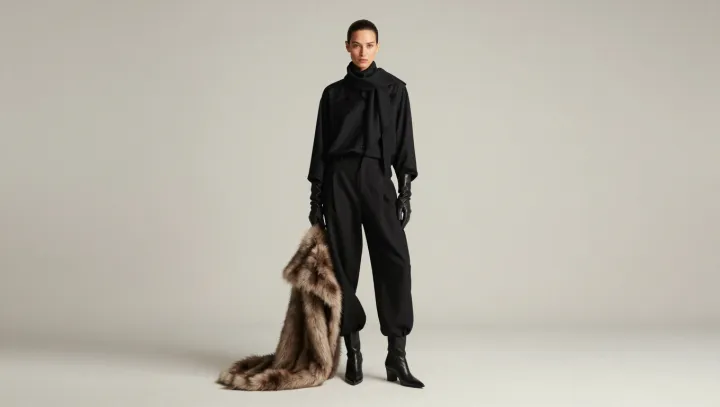
Black can be louder than color. In an outfit built from a tucked blouse, balloon trousers and boots, the drama comes not from competing shades but from the shift between a contained waist and a generous leg. The eye follows that change in volume before it registers any individual garment.
Proportion does the heavy lifting. Tucking the blouse gives the trousers a clear starting point, allowing their fullness to read as a deliberate shape rather than excess fabric. The boots provide a firmer visual base beneath the curved leg, while the space between cloth and body becomes part of the composition. Fashion designers call this negative space: the room a garment holds around its wearer. Here, it gives the silhouette air and makes movement visible as the trousers fold and release.
Texture gives black its range. A matte surface absorbs more light, while a smoother, shinier one reflects it, producing highlights that can separate adjacent pieces even when their colors match. Seams and folds deepen the effect, creating small shadows where the fabric turns away from the light. A colorful outfit may draw attention first to its palette; this one asks the eye to notice construction, surface and proportion. Against the darkness, even an empty pocket of space can look like a line drawn with light.