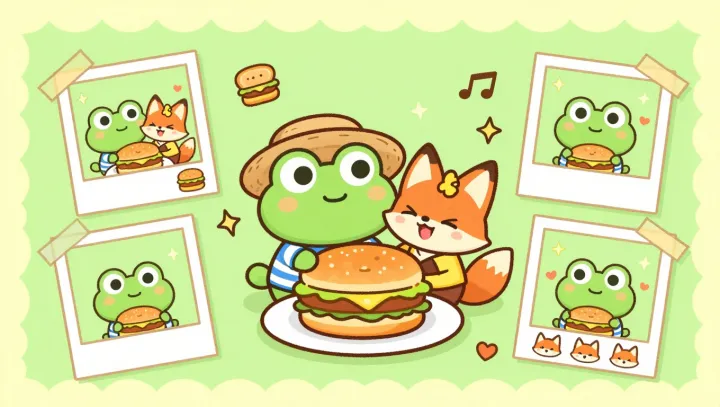
A face need not speak to be heard. Keroppi's expressive features and Hello Kitty's famously mouthless face take opposite routes toward the same destination: an emotional bond with the viewer. In a pastel illustration, Keroppi poses beside a fox companion and a frog-shaped burger, turning a simple meal into a scene ripe for interpretation.
Keroppi makes emotion visible. His large eyes and mobile mouth give an illustrator obvious tools for suggesting delight, surprise or concern; a slight change in their shape can alter the mood of a scene. In visual semiotics, such features act as signs that readers learn to interpret, while the fox, the burger and the soft colors supply context. The effect is not a precise emotional diagnosis. One viewer may see anticipation where another sees amusement, but Keroppi's face gives both somewhere to start.
Hello Kitty's restraint is just as expressive. Without a drawn mouth to settle her mood, her eyes, posture and surroundings carry more of the work, leaving room for viewers to bring their own feelings to the image. That openness is not the same as a blank personality: her recognizable silhouette and bow provide continuity even as the emotional setting changes. Keroppi offers a more explicit cue; Hello Kitty leaves a longer pause. Between a frog's grin and a cat's silence lies a question every character designer must answer: how much should a face tell us, and how much should it let us feel?