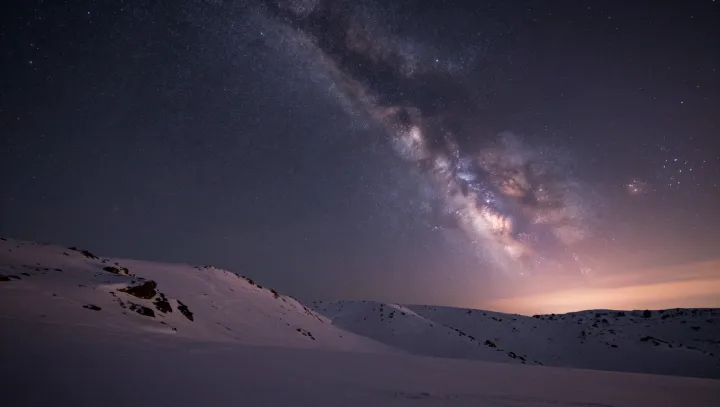
The Milky Way's bright band is evidence of an inside view, not a streak painted across the heavens. Above snowy mountains, countless stars merge into a pale glow because our line of sight runs through the crowded disk of our own galaxy, gathering light from distances too great for the eye to separate.
The band's shape gives away our address. The Milky Way is a barred spiral galaxy, and the Sun sits within its disk, roughly 27,000 light-years from the galactic center. Look along the galactic plane and the view passes through vast numbers of stars; look away from it and the stellar crowd thins. The disk encircles us. Its projection on the celestial sphere forms a great circle, although only part of that circle may be visible above the horizon at any moment. The apparent arc depends on the observer's location and the galaxy's orientation in the sky.
The gaps in the glow are as revealing as the light. Interstellar dust absorbs and scatters visible starlight, carving dark lanes through the band and concealing much of the galactic center from ordinary sight. Telescopes using infrared wavelengths can see through some of that dust, exposing stars hidden at visible wavelengths. Mountains add no galactic glow. Their snow catches light from the sky and the ground, while high elevations can offer thinner air; darkness and clear weather matter just as much for seeing faint stars. Above the peaks hangs a portrait drawn from within, its missing pieces as eloquent as its light.