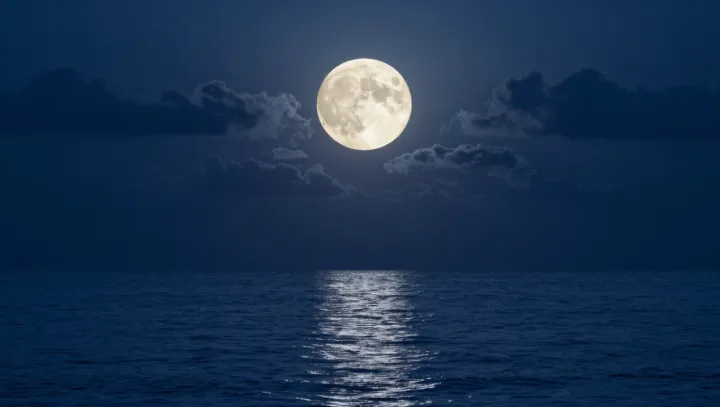
The full Moon cheats the arithmetic. Although it displays only twice the sunlit area visible at a half Moon, it can appear roughly ten times as bright. The difference lies not in any light of its own, but in how the dusty lunar surface returns sunlight to Earth.
The Moon is a poor mirror with a useful trick. Its surface is covered in regolith, a layer of dust and broken rock whose grains and craters cast shadows when sunlight arrives at an angle. At a half Moon, those shadows are plentiful, especially near the line dividing day from night. Near full phase, sunlight strikes from almost directly behind Earth, so many shadows fall out of sight behind the objects casting them. Astronomers call this shadow hiding. Another effect, coherent backscatter, can strengthen light returned toward its source as scattered waves reinforce one another. Together, these effects contribute to the opposition surge, a sharp rise in brightness near full phase.
The ocean adds its own illusion. Moonlight glitters across water because countless tilted wave surfaces reflect the light toward an observer, making a broken path that shifts as the waves move. The lunar geometry is less tidy than the picture suggests: exact alignment can put the Moon in Earth's shadow, producing a lunar eclipse rather than an ordinary full Moon. Most full Moons pass above or below that shadow. What looks like a silver road is only borrowed sunlight, scattered by dust and rearranged by water.