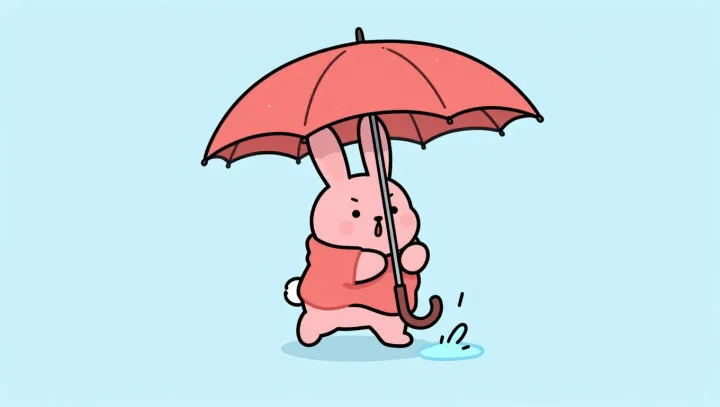
Rabbit ears do much of the talking. In an illustration, a pink cartoon rabbit clings to a closed red umbrella above a puddle, a compact rainy-day scene that invites the eye to read its pose. The ears can make that pose feel cautious, cheerful or startled before a face supplies any further clues.
Real ears offer richer material than the cartoon shorthand suggests. A rabbit can swivel its pinnae, the external parts of its ears, toward sounds; their movement contributes to auditory localization, helping the animal detect where sounds come from. Ear position also forms part of its body language, but it is not a reliable emotional label on its own. Posture and context matter. An ear held back, for instance, might accompany several different states rather than announce a single feeling.
Animation thrives on that ambiguity by making it simpler. Artists can stretch an ear upright for alertness, let both droop for disappointment or throw them backward to suggest speed or alarm. These are conventions, not translations. Their force comes from exaggeration and timing: a quick change in silhouette can register even when the character is small, while a pause lets the audience absorb the reaction. Against the red umbrella and the puddle, the pink rabbit needs few words. Its ears can lend the still image a hint of motion, as if the rain has just told it something.