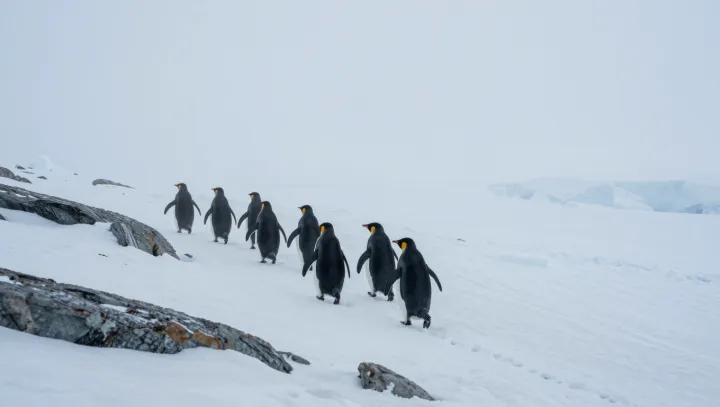
A penguin's waddle is less wasteful than it looks. With each step, the bird rocks from side to side, using a movement that can recover some mechanical energy rather than forcing its muscles to supply it all. The savings come with a catch: walking remains costly.
The sideways swing is a useful compromise, not a failure of balance. As weight shifts over a planted foot, the body rises and slows; as it moves down toward the next step, gravitational potential energy can be converted back into kinetic energy. The process resembles an inverted pendulum, with the supporting leg acting as the pivot. Nothing comes free, though. Energy is lost at each transition between feet, and muscles must work to move and stabilize the body.
The bill for walking remains high because a penguin's body is built for another medium. Short legs, set far back on the body, help give the bird its upright stance on land; in water, its streamlined shape and flippers support a different kind of movement. On land, short steps mean frequent footfalls, while supporting and redirecting the body demands muscular effort. The waddle recovers part of that cost, but it does not erase it. Across the ice, economy takes an awkward shape.