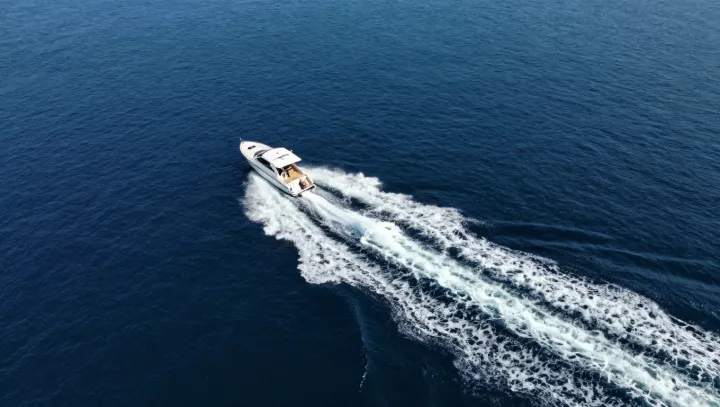
The V behind a motorboat is less a trail than a moving geometry. Waves spread in many directions from each point along the boat's path, yet their combined pattern has a recognizable outline. The water is not marching outward in two neat lines; it is recording a continuous succession of disturbances.
The shape owes more to timing than to force. As the hull moves, it generates waves at successive positions, and those waves overlap. Their interference reinforces some crests and weakens others, while dispersion causes waves of different wavelengths to travel at different speeds. Taken together, these effects produce a pattern that can remain steady relative to the boat, even as individual waves move through it. The crests do not stay put. The V is an envelope of the wave pattern, not a pair of waves racing away from the stern.
The textbook angle is a useful guide, not a guarantee. For an idealized source moving steadily through deep water, the Kelvin wake has a half-angle of about nineteen and a half degrees, measured from the boat's direction of travel to either edge. A real boat has size and shape, and its speed, the water depth, and other waves can change which crests are most visible. At high speeds, the visible wake can appear narrower than the ideal boundary. Foam complicates the picture. Churn from the propeller and breaking water can mark the boat's passage without tracing every wave beneath it. Behind the departing hull, the V holds its shape while the water that draws it moves on.