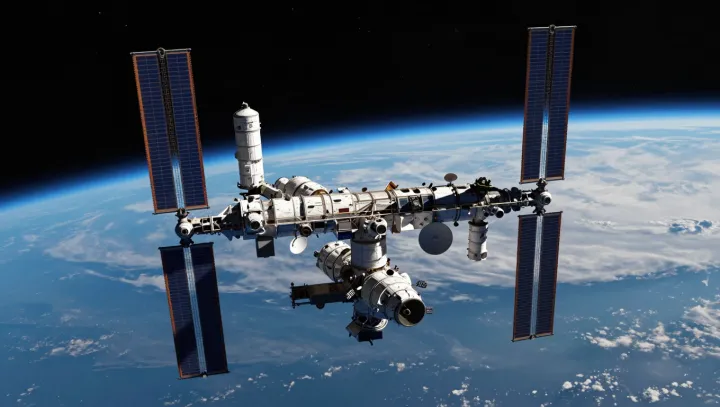
Gravity has not let go. Astronauts float because their station, its contents and the crew are falling together around Earth, moving sideways so quickly that the ground curves away beneath them. The apparent weightlessness inside is not an escape from gravity but a consequence of its pull.
Orbit is a bargain between motion and attraction. At the altitude of the International Space Station, roughly 400 kilometers above Earth, gravity remains close to 90 percent of its strength at the surface. The station travels sideways at about 7.7 kilometers per second, while gravity continually bends its path toward the planet. It keeps missing the ground. This shared free fall leaves astronauts without the supporting force a floor normally exerts on a person standing still, so they drift beside tools, droplets and loose cables.
Weightlessness is never quite perfect. The term microgravity acknowledges small disturbances from atmospheric drag, spacecraft motion and equipment vibrations. The station needs periodic boosts to counter drag, while solar arrays supply electricity and docked spacecraft carry people or cargo. Those systems make the inhabited orbit possible; they do not switch gravity off. Inside, a floating object offers a quiet reminder that falling can look remarkably like freedom.