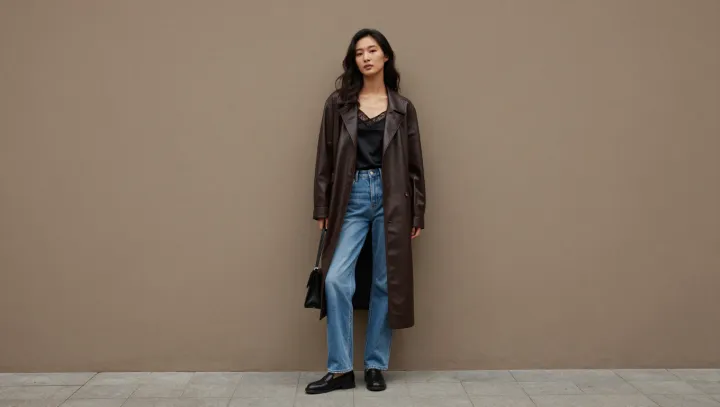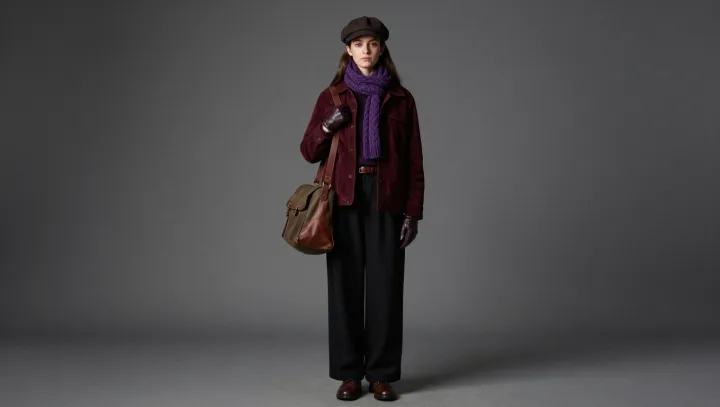
A purple scarf does not need a pale backdrop to brighten an outfit. It draws the eye upward. Set against a dark brown jacket and black wide-leg trousers, the color creates a distinct point of interest while leaving the larger, darker shapes in command.
The secret is contrast, not lightness. Purple can carry enough chroma to stand apart from brown and black without raising the overall value of the outfit; a deep plum or saturated violet, for instance, can feel vivid while remaining visually dark. Proportion matters as well. Because the scarf occupies a relatively small area near the face, it gives the eye somewhere to land without competing with the long line of the trousers. A loosely draped end can introduce movement, while a closer wrap creates a more compact accent.
Warm brown accessories make the color feel considered rather than isolated. Their shared warmth with the jacket softens the transition between purple and black, so the scarf reads as part of the outfit rather than an interruption. There is no need to match every brown precisely: a little variation adds depth, provided the accessories stay in the same general family. Nor must the purple be repeated elsewhere. One concentrated note is often more persuasive than several scattered ones. Against the dark tailoring, the scarf catches the eye without asking the shadows to disappear.