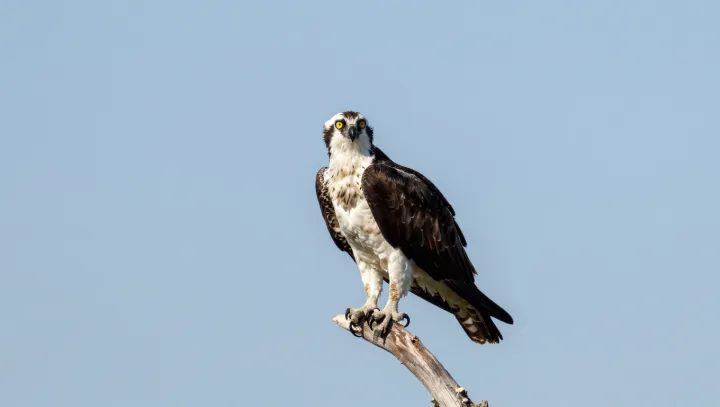
The hooked talons look formidable, but the osprey's grip is more adaptable than it first appears. One outer toe can swivel backward, allowing the bird to hold a fish with two toes in front and two behind. That arrangement matters. It gives the raptor a balanced grip on prey that can twist and thrash.
A firm hold is not just a matter of muscle. The undersides of the toes carry small, sharp projections called spicules, which help keep a slippery fish from sliding free, while long, curved talons sink into its body. This reversible toe arrangement, known as zygodactyly, is unusual among birds of prey. The osprey often turns its catch headfirst in flight, reducing drag as it carries the fish away. Each adjustment earns its keep.
The plunge demands as much precision as the grip. From above, the osprey uses keen vision to locate fish near the surface, then drops feet first, thrusting its legs forward to strike. Closable nostrils help keep water out during immersion, and dense, oily plumage resists soaking. The bird can briefly disappear beneath the surface before beating its wings to rise, though a fish that is too heavy may force it to release the catch. Once airborne, the dark stripe through its eye is visible again, above water that has closed over the struggle.