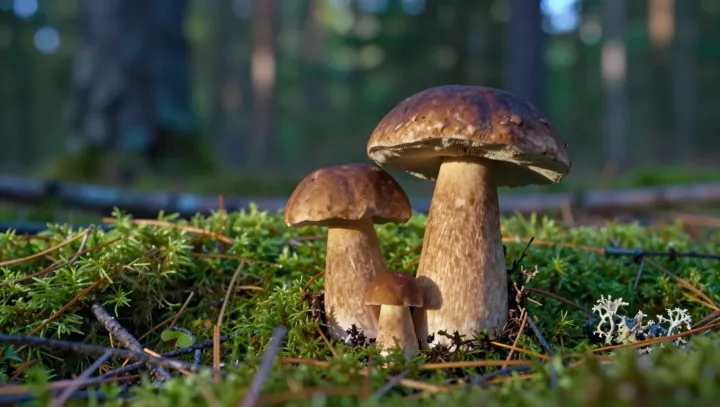
The bolete's most consequential bargain happens out of sight. Its broad brown cap and stout stem are the visible fruiting body of a fungus whose fine threads may be entwined with tree roots, trading resources across a boundary neither partner can cross as efficiently alone. The cap is only a trace.
This is commerce without a merchant. In many boletes, an ectomycorrhiza forms when fungal hyphae sheath a tree's fine roots and grow between their outer cells. The tree supplies sugars made by photosynthesis; the fungus absorbs water and nutrients, including phosphorus and nitrogen, from the soil. Its branching threads reach into pores and patches beyond the immediate reach of roots, while enzymes and organic acids can help release nutrients from soil materials. Roots can absorb nutrients themselves, but the fungus extends the area they can exploit. The exchange is not free: carbon sent underground is carbon the tree cannot spend on its own growth.
The fungus faces the sharper constraint. It cannot photosynthesize, so a tree's access to sunlight gives it a source of carbon that soil alone cannot readily provide in the same form. The tree, for its part, cannot match the reach of fine fungal threads simply by making more roots without paying the costs of building and maintaining them. These partnerships vary with species and conditions, and not every bolete makes the same arrangement. Beneath one brown cap, an unseen boundary holds two unequal hungers in balance.