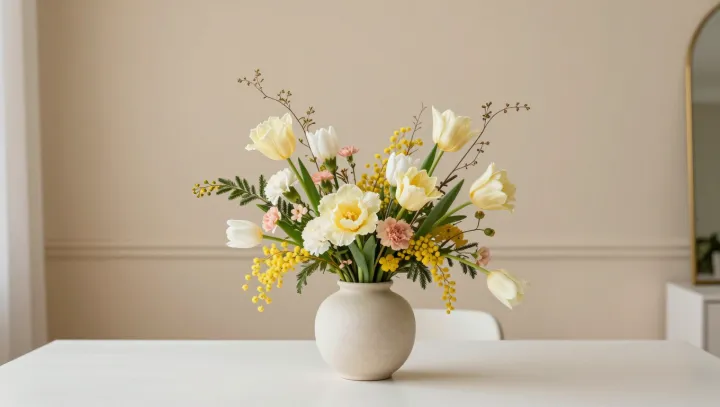
A flower arrangement can unite a room without matching a single piece of furniture. Color is only one part of the story. Yellow and white blooms in a rounded vase give a neutral setting a focal point, while their shapes and textures draw attention to relationships that might otherwise go unnoticed.
Cohesion depends less on matching than on visual hierarchy: the way a room directs the eye among its features. The flowers can take the lead. Against restrained furnishings, their color stands apart, yet the white petals may echo a pale wall or cushion, giving the arrangement a subtle connection to its surroundings. The vase contributes differently. Its curved outline can pick up the shape of a lamp, a table edge, or the soft profile of a chair, even when their materials and colors differ. Such repetition gives the eye a route through the room without demanding that every object look alike.
Contrast, too, can make a room feel more considered rather than less coherent. Petals and stems introduce irregular forms beside the steady lines of furniture, while the vase gives those loose elements a contained base. Placement matters. On a table with enough clear space around it, the arrangement can register as an intentional composition; crowded among small objects, it may simply add to the clutter. The flowers need not carry every color in the room. A shared curve, a pale petal, or the balance between an animated bouquet and a quiet surface may be enough. The room holds its differences together, with a small burst of yellow at its center.