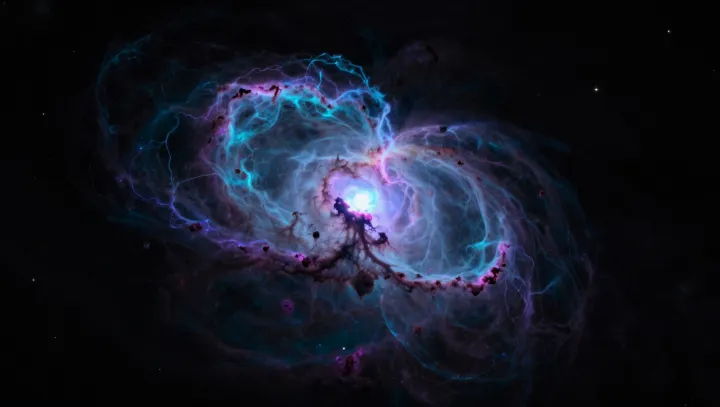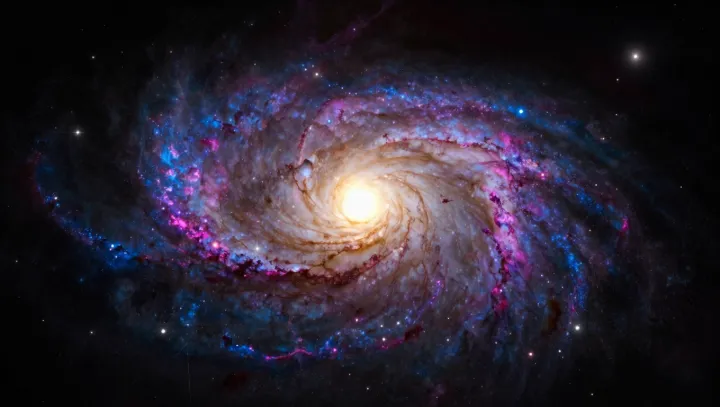
Light from a distant spiral galaxy is already old on arrival. Across the dark, photons stream along geodesics in spacetime, carrying a snapshot of the galaxy as it was when they left, not as it is now.
This is not a poetic flourish; it is baked into finite light speed and the metric expansion of space. A galaxy so remote that its spectrum shows strong cosmological redshift is seen at an earlier cosmic epoch, because each photon has spent an enormous interval crossing an expanding universe whose scale factor kept stretching the path mid‑journey.
Astronomers treat the night sky as a time‑stacked archive, not a live feed. When telescopes capture the spiral arms, star‑forming regions, and dust lanes of a faraway system, the detectors record radiation emitted when its stellar population was younger and its dark matter halo less dynamically settled, turning every deep exposure into a kind of archaeological layer cut into the sky.