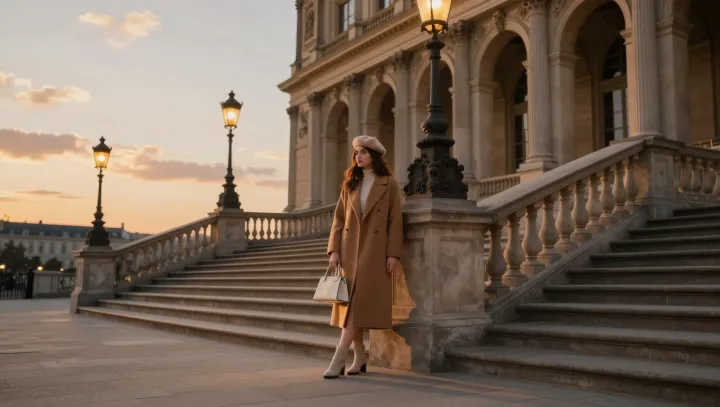
Light, not gear, does the real editing here. A camel‑toned outfit on a pale stone staircase turns low‑angle sunset rays into a giant, invisible modifier, as if the sky had been stretched into one seamless softbox. Because the sun sits near the horizon, its beam arrives as a broad, raking source, expanding the apparent size of the emitter and dropping the lighting ratio between highlight and shadow to studio‑friendly levels.
More surprising is how architecture, not equipment, cleans the frame. Each stair tread acts as a neutral reflector, stacking planes that bounce photons upward and forward, filling eye sockets the way a clamshell beauty setup would rely on a reflector and key light. The camel fabric, close to mid‑tone in luminance and low in saturation, avoids specular hotspots and keeps dynamic range within what a camera sensor can capture without aggressive noise‑lifting in the shadows.
The real gain is silhouette control. With the background locked to uniform stone, edge contrast becomes a function of contour, not clutter, so the subject reads as a crisp figure‑ground separation even at wide apertures. Many studio rigs chase this with flags, grids and scrims; here, the physics of diffuse reflection and color temperature alignment finish the job before a single modifier is unpacked.