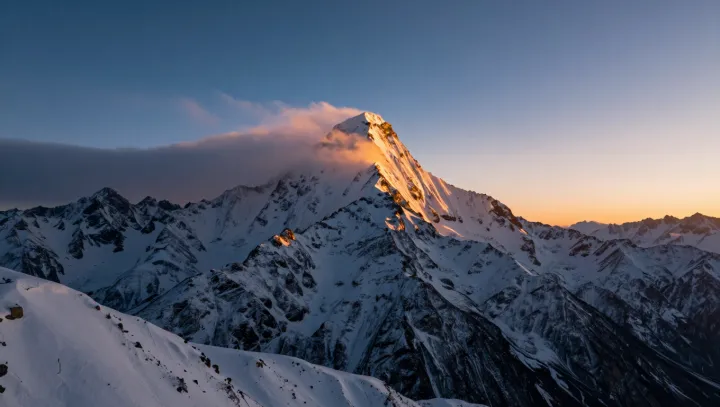
Golden fire on the summit is not romance. It is geometry and optics doing simple work in a dramatic way. As the Sun sinks, its rays scrape almost tangentially across the curved Earth, so the last clear line of sight from space touches only the highest terrain while lower ground already lies behind the planet’s shadow boundary.
That height difference sounds trivial. It is not. Even a few hundred vertical meters shift the horizon angle enough that mountaintops still intercept direct solar radiation while the valley floor receives only diffuse skylight produced by Rayleigh scattering in the upper atmosphere and Mie scattering from aerosols, light that is weaker and richer in shorter, bluish wavelengths.
The summit glow also cheats your eyes. Warm, low-angle light has traveled through a long air column, which filters out much of the blue and green spectrum and leaves a red and yellow heavy beam that stone and snow reflect with high contrast against the darkened surroundings. In the valley, illumination is already indirect, so objects are lit mainly by that scattered blue component and feel colder, flatter, almost submerged.
So the mountain does not shine more; it simply stays in the beam a little longer. The valley falls out of the direct optical circuit first, and your visual system turns that small geometric lead into a striking split screen of gold above and shadow below.