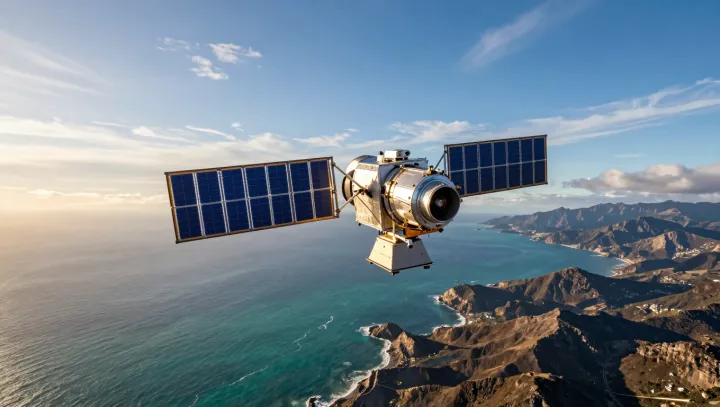
Sunset light is not gentle at all. What feels like a curtain closing is, in geometric optics terms, a low-angle beam skimming just above the sea surface, compressing power into a thin horizontal sheet. Because the solar disk sits near the horizon, the same irradiance now travels almost sideways across cliffs and waves, stretching shadows and steepening tonal differences across even tiny height changes.
The real trick is angle, not intensity. Atmospheric scattering reduces direct solar flux, yet the grazing incidence multiplies the effective path a ray travels across each rock face or ripple, so micro-relief throws shadows far longer than at midday. Radiative transfer and surface roughness physics combine to act like a directional scanner, where every millimeter of protruding foam or stone interrupts the beam and casts a crisp dark edge against the lit side, raising local contrast beyond what the raw power level suggests.
Human vision misreads this as softness. The spectral shift toward longer wavelengths and the reduced luminance push the eye toward a more relaxed pupil response, while the visual system compresses bright highlights on water through photoreceptor adaptation. Yet the underlying illumination field is brutally selective, lighting only the faces oriented toward the low sun. Along a coast, that selectivity behaves like a gold detector, sweeping horizontally, pinging off each bump and ripple, and flagging them in hard light and deep shadow.