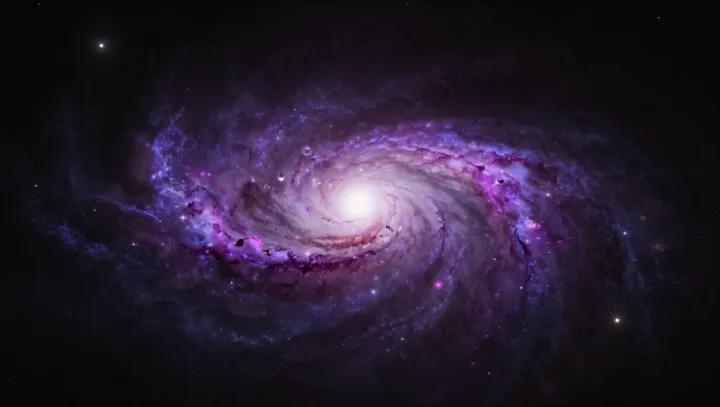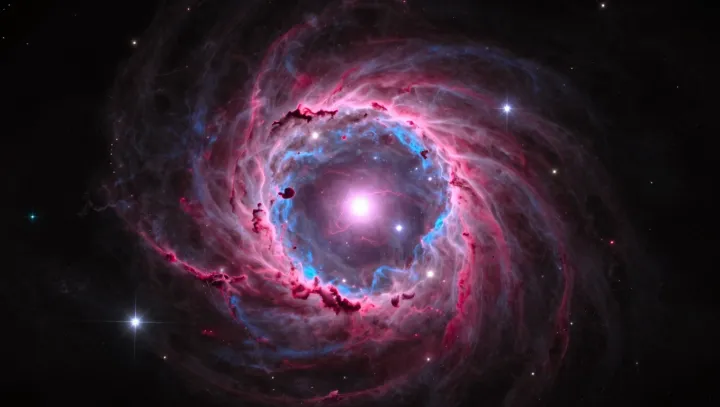
That lopsided purple ring is not fragile at all. It is a working boundary, a shock front where physics turns violent structure into apparent delicacy, as high-speed stellar wind rams into slower gas already shed by the dying star and forces it into a sharp, glowing rim.
The odd shape is no flaw. Fast wind from the exposed stellar core plows outward at hundreds of kilometers per second, slamming into older material that crawls away far more slowly, and the abrupt jump in density, temperature, and velocity marks a classic hydrodynamic shock front rather than a gentle halo. Gas there is heated to emit specific spectral lines, especially from ionized oxygen and hydrogen, which telescopes map into purples and violets, so the ring’s color is a code for extreme compression and shock heating, not for fragility.
What looks like a broken loop is simply geometry exposed. Because the surrounding gas is uneven and the shock surface is really a three-dimensional shell, some segments face Earth and shine brightly while others are foreshortened or hidden, so the ring appears warped and incomplete although the underlying structure is a coherent, expanding shock. Astronomers track its expansion rate and use radiative cooling models and emission-line diagnostics to reconstruct the wind speed, the mass loss history, and the density of the interstellar medium, all from that apparently delicate purple arc.