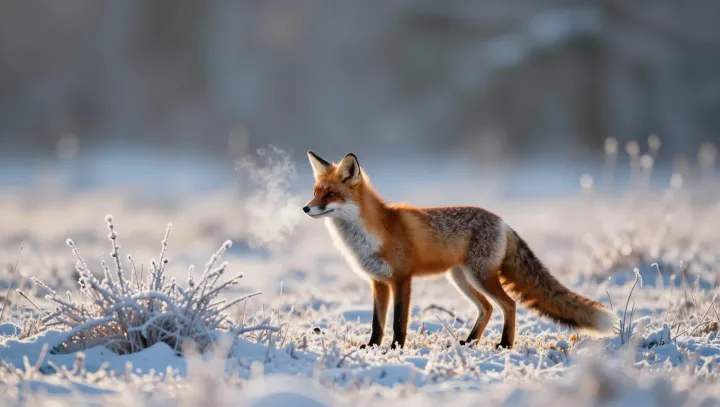
Stillness here is not calm but calculation. In a frozen meadow, a red fox locks every limb, turning its own body into a noise source so faint that it almost disappears, because any rustle from fur or snow would mask the tiny acoustic trace of a mouse tunneling below.
What looks like a pause is actually a full sensory protocol. Large, forward-facing ears act as paired parabolic dishes, feeding slightly different arrival times of sound into the fox’s auditory cortex, which performs interaural time difference and interaural level difference processing to triangulate the source. Short ears would fail; these tall, mobile pinnae allow rapid scanning without shifting the torso, so the animal avoids introducing low-frequency interference from its own movement.
The real advantage, though, comes from how the fox uses the snow. The crust behaves like a mixed acoustic and mechanical filter, damping high-frequency noise while carrying low-frequency components of scratching and chewing as both airborne sound and substrate-borne vibration. By keeping its head at a fixed angle and its body weight balanced through proprioceptive feedback, the fox maintains a stable reference frame, letting minuscule phase shifts and amplitude changes stand out against the ambient wind. Only when the internal model of direction, range and depth aligns does the statue break, body arcing into a high jump that ends with a plunge through the snow, aimed at a point it has never seen.