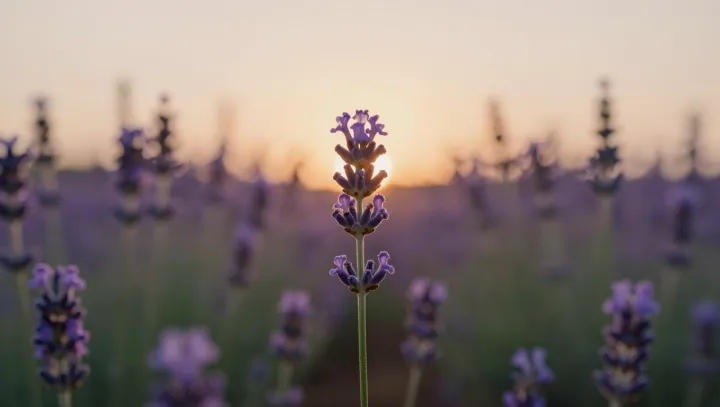
The solitary stem cheats. At sunset, a low sun sits almost behind it, so the narrow stalk and its fine hairs intercept light at an angle that makes their edges blaze against a dimmer background. It steals the eye. The field, though richer in flowers, has no such clean boundary.
The haze is no failure. A field is a crowd of overlapping petals, stems, and gaps, each sending light through a different path; their colors mix through spatial averaging, a form of visual integration, while airborne scattering softens contrast across the longer view. Focus decides the rest. In a photograph, a wide aperture confines acceptable sharpness to the chosen stem, and defocus broadens each remote point into a circle of confusion, described by the lens's point-spread function. The optic is editing, not merely recording. Even without a camera, the eye favors the high-contrast edge, then relaxes accommodation over the mass beyond. Sunset adds a warm spectral bias, but the apparent purple arises from anthocyanins, backlighting, and chromatic adaptation, which judges each tone against its neighbor.
The lesson is almost rude. Geometry, wavelength, and attention grant the isolated stem a clean signal, while the field pays for abundance with overlap. At dusk, one stalk keeps its border; the many surrender theirs.